The Car Sleeper — Vienna to Split
Bvcmz248.5 / Wikimedia Commons · CC0 · cropped
- Duration15 h 07 southbound · 16 h 09 coming back
- Best seasonSummer only · three nights a week, ending late September
Introduction
Most night trains ask you to leave the car at home. This one takes it with you.
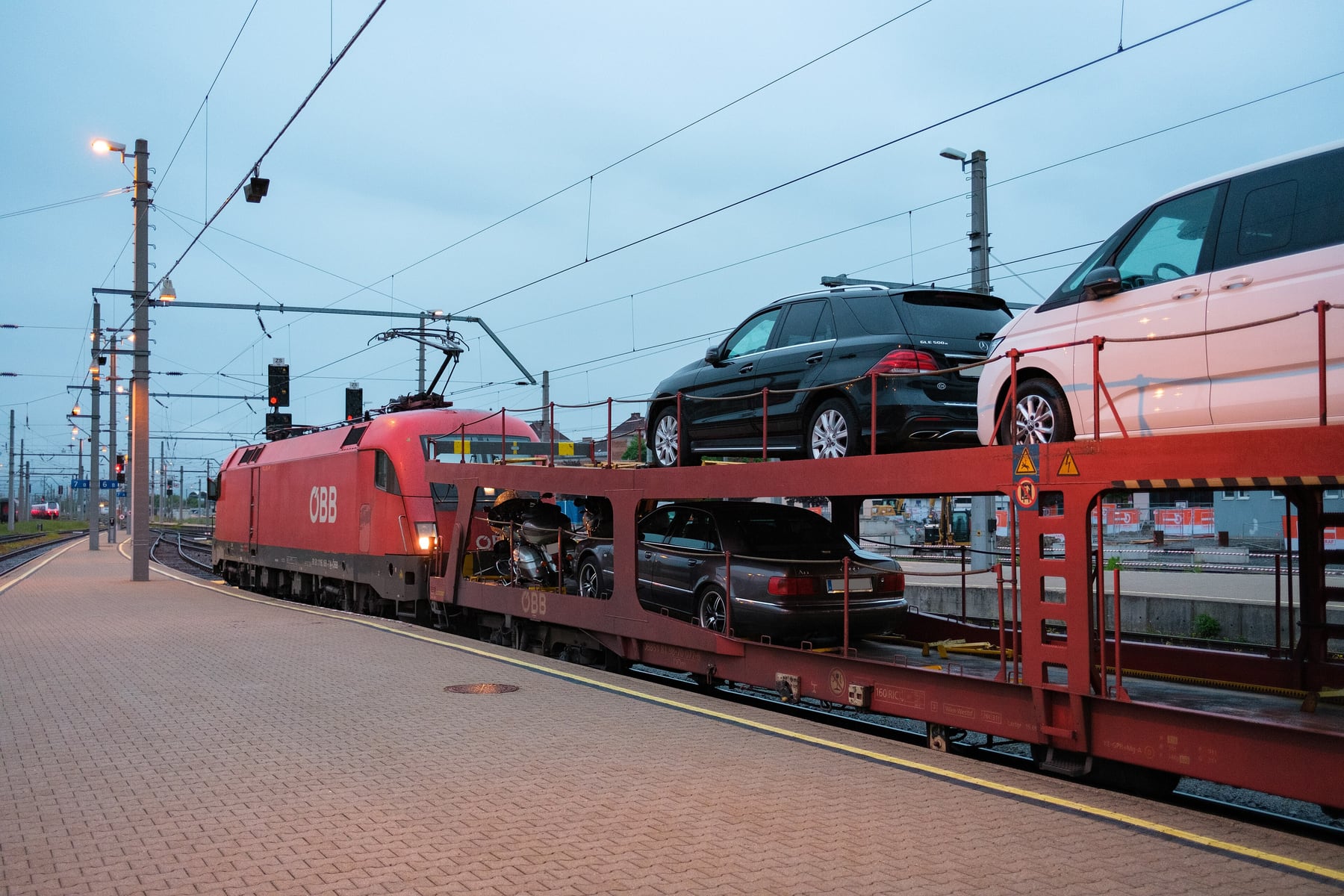
Three evenings a week through the summer, a EuroNight pulls out of Vienna with a sleeping car, a couchette car, a handful of second-class seats and — coupled on the back — two double-deck wagons carrying the passengers' own cars and motorbikes. Fifteen hours later it sets them down on the Dalmatian coast at Split, and the cars come off a ramp a few minutes' walk from the walls of a Roman palace. It is the only way to reach Croatia by rail without leaving your own vehicle behind, and for about a thousand kilometres of Austrian, Slovenian and Croatian motorway, that is the entire point.
The service is young, and it has already lost half of itself. ÖBB launched it on 18 June 2021 together with Slovak Railways, as trains EN 1253 and 1252, running twice a week from Bratislava through Vienna and Graz to the sea. A ZSSK board member marked the occasion by calling the Croatian Adriatic the "Slovakian sea" — the joke being that his country has no coast, and neither does Austria, and this train was built to lend them one. The Slovak portion has since been dropped. What remains starts at Vienna, runs three nights a week rather than two, and is numbered EN 1273 going south and EN 1272 coming back.
A train that cannot stop where it stops
What makes it strange, once you look at the timetable properly, is how little of it you are allowed to use. Going south, every Austrian station is marked for boarding only and every Croatian one for setting down only; coming north, the rule reverses. The train calls at Zagreb and it calls at Split, and it takes eight and a half hours to travel between them, but no ticket is sold for that journey. It has no right to carry anyone within either country — it is an Austrian train passing through, and Croatia's own railway does not list it in its timetable books at all.
The route is worth staying awake for at both ends. Out of Vienna it climbs the Semmering, finished in 1854 and generally reckoned the first true mountain railway in the world, a UNESCO site since 1998 that trains still cross because the tunnel meant to replace it will not open until 2029. Then Graz, the Slovenian border in the dark, Zagreb at half past one in the morning — and a long, deliberate crawl across the Lika highlands that gets the train to Knin at twenty to eight, with the light, and down to the Adriatic by mid-morning.
The Journey
The evening begins earlier than the departure does. Cars and motorbikes for the southbound train are taken from 17:00, and ÖBB's wording is precise about it: the vehicle has to be presented at the start of the loading period, not by the end of it. The train itself does not leave until 18:57. That two-hour gap is the shape of the day — the car goes first, and its owner follows.
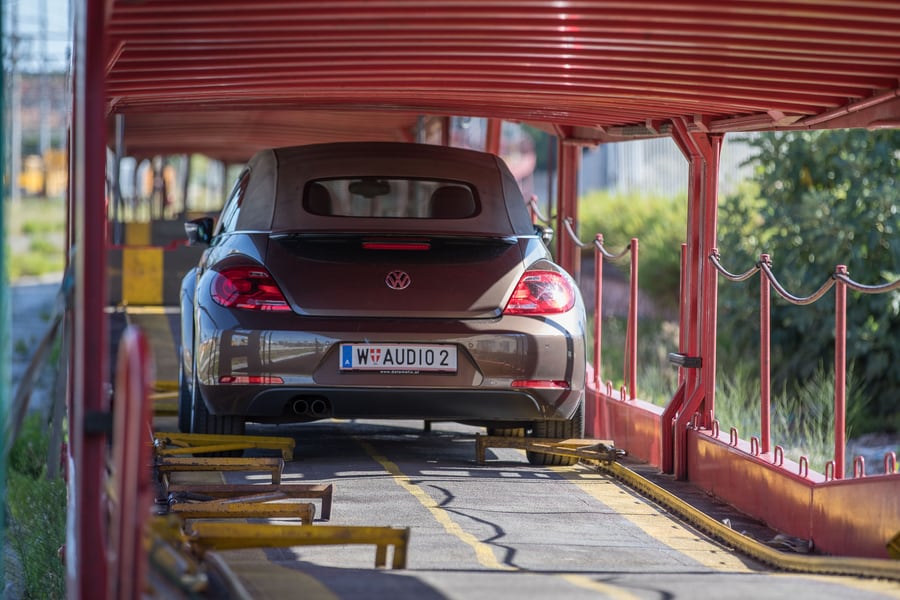
Loading happens at a separate terminal at Vienna Hauptbahnhof, which the timetable treats as its own station, distinct from the platforms the passengers use. Owners drive up the ramp themselves; the staff do the securing. The list of things asked of the driver is short and specific — aerial retracted or removed, alarm switched off, windows closed, first gear engaged, handbrake on, doors locked — and one line matters more than the rest: nobody and no animal may stay in the vehicle. Motorcycles go on the lower deck and can be up to 158 cm tall including the fairing. The wagons run at up to 160 km/h, and the vehicle is insured for the length of the transport.
Out of Vienna and over the Semmering
The train picks up at the main platforms at 19:05, at Wien Meidling at 19:12, and at Wiener Neustadt at 19:43. After that it begins the climb that makes the first half of this journey worth being awake for.
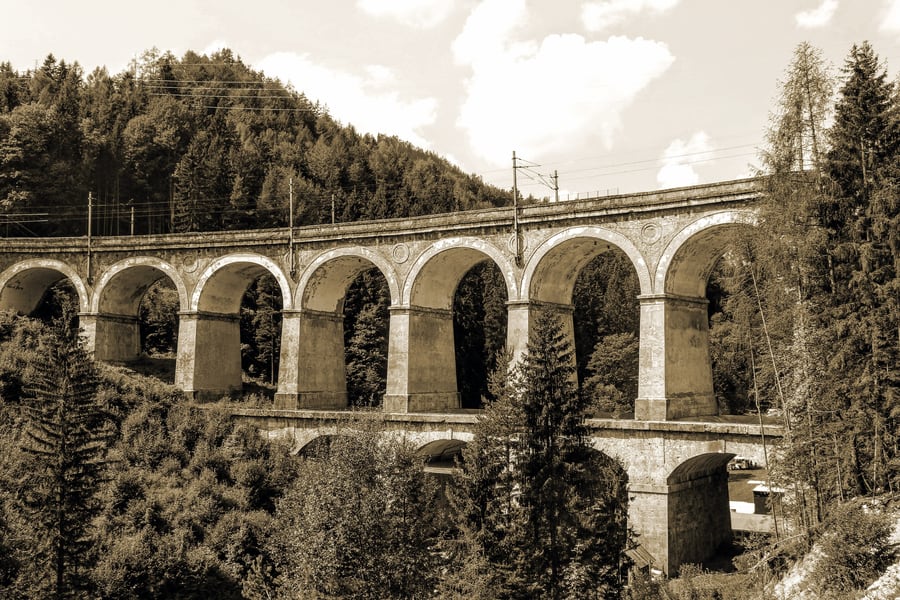
The Semmering was built between 1848 and 1854 to Carl von Ghega's design: forty-one kilometres of standard-gauge railway over the pass between Gloggnitz and Mürzzuschlag, taking 460 metres of altitude with fourteen tunnels, sixteen viaducts and more than a hundred stone arch bridges. It is commonly called the first true mountain railway in the world, and UNESCO added it to the World Heritage list in 1998. A base tunnel beneath it has been under construction for years and is due to open in 2029; until it does, everything still goes over the top, this train included.
Southbound the crossing falls between 19:43 and 21:15, so how much of it you see depends entirely on the date. Northbound is the reliable one: the return working is on the pass between 07:05 and 08:46, after breakfast, in daylight, on every run of the season.
The border, and a station that is not the main one
Graz at 21:55 is the last Austrian pick-up and the second place the train can be joined — though not with a car, since the loading bays for this service are published for Vienna and Split and nowhere else. The Slovenian border follows at Spielfeld-Straß, then Maribor at 22:56 and Celje at 23:49, both worked as ordinary calls in both directions.
At Dobova, on the Slovenian-Croatian frontier, the train stands for twenty minutes in the middle of the night. Then comes Zagreb at 01:37 — but not Zagreb Glavni kolodvor, the grand terminus everything else uses. This train calls at Zagreb Zapadni kolodvor, the West station, and only to set passengers down.
The slow morning across the Lika
From Zagreb the train turns south onto the line to the coast and then, quite deliberately, dawdles. It leaves Oštarije at 03:30 and does not reach Knin until 07:41 — a little over four hours for a stretch the daytime trains cover in about three. The extra time is not lost; it is spent, so that the emptiest and highest part of the route arrives in daylight rather than at four in the morning.
This is the Lika railway, the line Austria-Hungary began in 1913 and a successor state finished in 1925, and the night train sees it at the opposite end of the clock from the day service. Beyond Knin the descent runs down the Krka valley to Perković at 08:35, and then the last stretch turns for the sea. Split at 10:04, and the cars are unloaded onto the same waterfront.
Coming back is a longer night — sixteen hours and nine minutes against fifteen and seven — because the northbound working leaves Split at 17:20, in daylight, and crosses the Lika in the evening instead.
Along the route
M Kastelic / Wikimedia Commons · CC BY-SA 4.0 · croppedThe passengers bring their cars
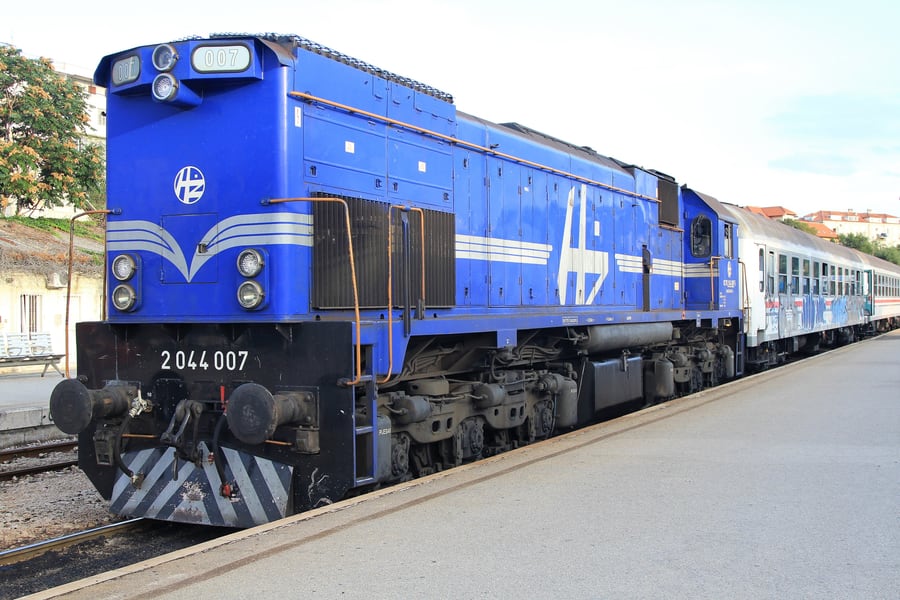
Two car-carrier wagons run at the back of this train, and they are the reason it exists. Owners drive up the ramp themselves, then the aerial comes down, first gear and the handbrake go on, and the car is locked and left. Nobody and no animal may stay aboard it.Bahnfrend / Wikimedia Commons · CC BY-SA 4.0 · croppedIt used to start in Slovakia
ÖBB launched the service in June 2021 with Slovak Railways, running twice a week from Bratislava. A ZSSK board member described the Croatian Adriatic that day as the "Slovakian sea" — neither country has one. The Slovak portion has since gone.Ritschie61 / Wikimedia Commons · CC BY-SA 4.0 · croppedOver the world's first mountain railway
Between Wiener Neustadt and Bruck the train climbs the Semmering, built from 1848 to Carl von Ghega's design with 14 tunnels and 16 viaducts, and UNESCO-listed since 1998. A base tunnel underneath is due in 2029; until then every train takes the old road over the top.A bit of history
Culture & experiences along the way
Rob Hodgkins / Wikimedia Commons · CC BY-SA 2.0 · croppedYou cannot use it inside Croatia
The train has no domestic traffic rights on either side of the border. Going south, every Austrian stop is marked for boarding only and every Croatian stop for setting down only; coming north it is the other way round. So a seat from Vienna to Split is sold, and a seat from Zagreb to Split is not — even though the train calls at both and takes eight and a half hours over the distance between them. Falk2 / Wikimedia Commons · CC BY-SA 3.0 de · cropped
The car has to be there before you are
Loading closes long before departure. Southbound the vehicles are taken from 17:00 for a 18:57 departure; northbound from 15:00 for 17:20. ÖBB's wording is that the vehicle must be presented at the start of the loading period, not by the end of it, and its general guidance is that loading opens one to two hours before the train leaves. That is the appointment the day is built around.Bahnfrend / Wikimedia Commons · CC BY-SA 4.0 · croppedWhat the wagons will not take
The booking asks for make, model, year, registration and the vehicle's dimensions including roof and rear racks. Cars with pop-up or elevating roofs, and camper hardtops, are not carried at all. Anything not in ÖBB's vehicle database — a classic car, a trailer, a trike — can usually still travel, but has to be booked through a ticket office rather than online. Locked ski boxes are allowed; ski bags are not. Vojtěch Dočkal / Wikimedia Commons · CC BY-SA 4.0 · cropped
Two stations called Zagreb
The train does not use Zagreb Glavni kolodvor, the grand terminus on the city's main axis. It calls instead at Zagreb Zapadni kolodvor, the West station, at 01:37 southbound and 02:05 northbound, and only to set down or pick up international passengers. Croatia's own operator does not list this train in its timetable books at all, which follows from its having no right to carry anyone within the country. Perun / Wikimedia Commons · CC BY-SA 3.0 · cropped
Morning on the Lika
The slowest part of the run is the best-timed. Southbound the train leaves Oštarije at 03:30 and does not reach Knin until 07:41 — four hours for a stretch the day trains cover in three — so the Lika highlands arrive with the light. It is the same line the Zagreb–Split day train uses, seen at the other end of the clock.Timetables
Times below are read from ÖBB's own timetable system, queried on 15 August 2026 — not from a planner's summary. The service is seasonal and runs three nights a week in each direction.
Southbound — EN 1273, Vienna to Split
Runs Wednesdays, Fridays and Sundays. The last departure of the 2026 season is Friday 25 September.
| Wien Hbf (vehicle terminal) | 18:57 |
| Wien Hbf (platforms) | 19:05 |
| Wien Meidling | 19:12 |
| Wiener Neustadt | 19:43 |
| Bruck an der Mur | 21:15 |
| Graz Hbf | 21:55 |
| Spielfeld-Straß | 22:35 |
| Maribor | 22:56 / 23:00 |
| Celje | 23:49 / 23:51 |
| Dobova | 00:55 / 01:15 |
| Zagreb Zapadni kolodvor | 01:37 |
| Oštarije | 03:30 |
| Knin | 07:41 |
| Perković | 08:35 |
| Split | 10:04 |
Every Austrian stop takes passengers on only; every Croatian stop sets them down only.
Northbound — EN 1272, Split to Vienna
Runs Mondays, Thursdays and Saturdays. The last departure of the 2026 season is Saturday 26 September.
| Split | 17:20 |
| Perković | 18:32 |
| Knin | 19:59 |
| Oštarije | 23:57 |
| Zagreb Zapadni kolodvor | 02:05 |
| Dobova | 02:27 / 02:45 |
| Celje | 03:51 / 03:53 |
| Maribor | 04:43 / 04:49 |
| Spielfeld-Straß | 05:11 |
| Graz Hbf | 06:16 |
| Bruck an der Mur | 07:05 |
| Wiener Neustadt | 08:46 |
| Wien Meidling | 09:16 |
| Wien Hbf (platforms) | 09:23 |
| Wien Hbf (vehicle terminal) | 09:29 |
Here the rule reverses: Croatian stops take passengers on only, Austrian stops set them down only.
Loading times for vehicles
These are the appointments that matter, and they are published per train:
| Loading opens | Train leaves | |
|---|---|---|
| EN 1273 (Vienna → Split) | 17:00 | 18:57 |
| EN 1272 (Split → Vienna) | 15:00 | 17:20 |
The same time applies to cars and motorcycles, and ÖBB asks for the vehicle to be there when loading opens, not merely before it closes. Its general guidance is that loading begins one to two hours ahead of departure.
What that means in practice
Southbound is fifteen hours and seven minutes; northbound is sixteen hours and nine. Three nights a week each way means the outward and return days do not mirror each other — leaving Vienna on a Wednesday, Friday or Sunday, and Split on a Monday, Thursday or Saturday — so a return trip needs both halves checked against the calendar rather than assumed.
The season ends in late September. A start date for the 2026 season is not published by the operator and is not stated here for that reason; the service was running when these times were read.
ÖBB publishes the live timetable and sells tickets at nightjet.com (opens in a new tab), with vehicle bookings handled through the car and motorcycle pages (opens in a new tab) or by telephone on +43 (0)5 1717.
Tickets
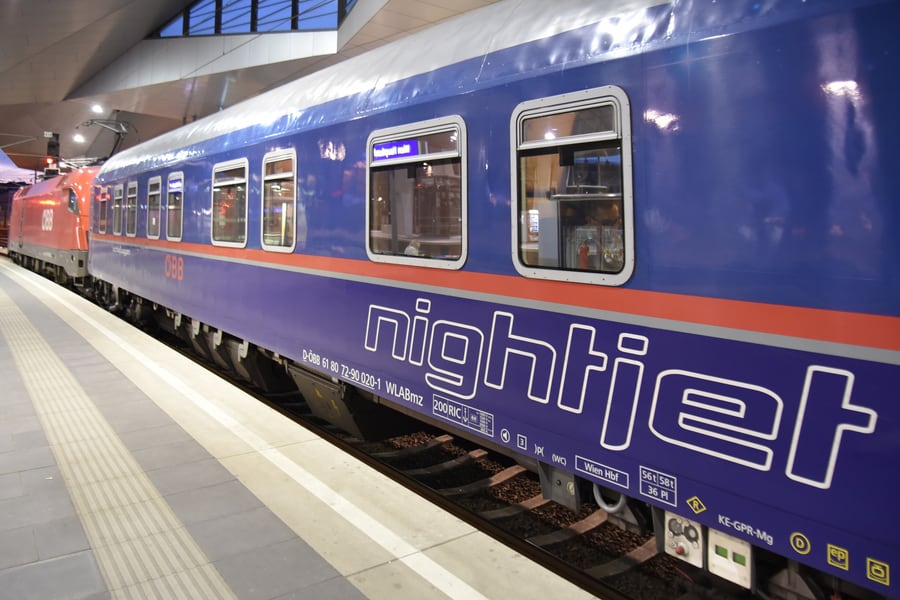
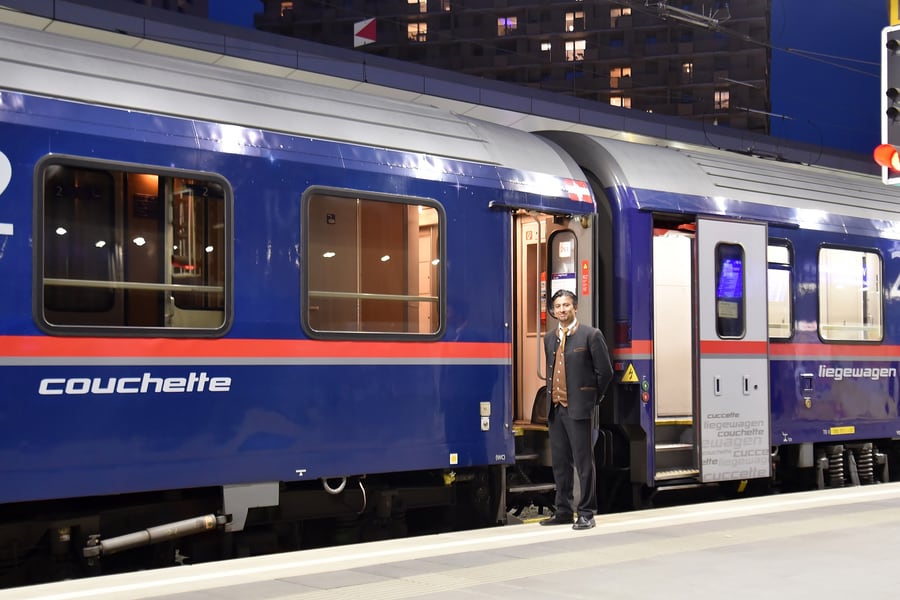
Two bookings are needed for a car journey on this train, and they are separate things: a ticket for the vehicle and a ticket for every person travelling with it. Reservation is compulsory and the accommodation chosen at booking — a sleeping car, a couchette car and second-class seats, with no first class and no restaurant car. ⚠️ This is a EuroNight rather than one of ÖBB's own Nightjet workings, and the operator is explicit that the stock and the service can differ from the Nightjet standard, so the newer cabins advertised elsewhere are not what is promised here.
Vehicle bookings also open six months ahead and need the make, model, year, registration and measurements including any roof box or rear rack. Cars with pop-up or elevating roofs are not carried at all, and anything absent from ÖBB's database has to be booked by telephone or at a counter rather than online.
Book your tickets
Bahnfrend / Wikimedia Commons · CC BY-SA 4.0 · croppedA berth from Vienna to Split
Sleeper, couchette or a second-class seat
Reservation is compulsory and built into the ticket. The train carries a sleeping car, a couchette car and second-class seats, with drinks and breakfast brought round by the attendant rather than served in a restaurant car. ÖBB sells online, through its app, at Austrian ticket counters and by telephone, and its cheaper Sparschiene fares are released up to six months ahead in limited numbers per departure.
Book Tickets (opens in a new tab, on nightjet.com)via nightjet.comM Kastelic / Wikimedia Commons · CC BY-SA 4.0 · croppedA ticket for the car or the motorbike
Booked separately from your own
The vehicle needs its own ticket, and so does every person travelling with it. Bookings open six months ahead and need the make, model, year, registration and the measurements including any roof or rear rack. Cancellation is free until fifteen days before the first day of validity, then half the fare — at least fifteen euros — until the day before, and nothing after that. Austrian motoring-club members are offered a discount.
Book Tickets (opens in a new tab, on nightjet.com)via nightjet.comRail Passes
This journey crosses three countries — Austria, Slovenia and Croatia — in a single night, which settles the pass question before it is really asked: a One Country Pass covers none of it. Only a Global Pass, or three separate country passes bought together, will carry you the whole way.
Interrail's own rules for night trains are worth reading before assuming a pass saves money here:
- Reservations are compulsory on every night train, and are never included in the pass — not even with a first-class pass. They are bought separately and in addition.
- The reservation fee rises with the comfort category, so a sleeper berth costs meaningfully more to reserve than a seat.
- Only the departure day is written on the pass. A train leaving on the 19th and arriving on the 20th uses one travel day, not two.
- The departure day may not be the last day of the pass's validity, which catches people planning the night train as the final leg of a trip.
Whether it is worth it
For this particular train, often not. Because the reservation and the accommodation supplement are payable regardless, a pass holder and a ticket holder end up paying much the same for the part of the night that actually costs money — the berth. The pass saves the base fare, which on a discounted Sparschiene booking made months ahead may be the smaller half of the total.
The case improves if the night train is one leg of a longer European trip that a Global Pass is already covering, and it improves again for anyone travelling seated rather than in a berth, where the reservation is cheaper and the pass is doing more of the work.
And there is one thing no pass touches at all: the car. The vehicle's ticket is a separate booking and a separate charge, unaffected by any rail pass, which is worth building into the sum before deciding.
Pass conditions checked against Interrail's published night-train rules in August 2026.
Places to Visit
This train is unusual in that its stops are not really invitations to break the journey — the Croatian ones are set-down only going south and pick-up only coming back, and Zagreb arrives at half past one in the morning. What it offers instead is two proper cities at the Austrian end, a mountain crossing in the middle, and the Dalmatian coast at the far side of the night.
The places below follow that shape: a day in Vienna before the evening departure, the Semmering while there is still light in the sky, Graz as the alternative starting point, and then the two Croatian stops the timetable actually leaves in daylight — Knin in the early morning, and Split at the end of the line.
 Steven Lek / Wikimedia Commons · CC BY-SA 4.0 · cropped
Vienna, before the evening train
The train goes out in the evening, which leaves a whole day in Vienna to spend first. The Belvedere is a pair of Baroque palaces set either end of a formal garden on the slope above the city, built as the summer residence of Prince Eugene of Savoy to Johann Lukas von Hildebrandt's design and finished early in the eighteenth century. It now holds Austrian art from the Middle Ages onwards, including Klimt's The Kiss. Liberaler Humanist / Wikimedia Commons · CC BY-SA 4.0 · cropped
The Semmering pass
Carl von Ghega's railway over the Semmering was finished in 1854 and is generally called the first true mountain railway in the world — the first built to standard gauge over a pass of this size, with fourteen tunnels and sixteen viaducts curving around the hillsides. UNESCO listed it in 1998. The northbound train crosses it between 07:05 and 08:46, which is the one part of this journey reliably seen in daylight. GFreihalter / Wikimedia Commons · CC BY-SA 4.0 · cropped
Graz and its Schlossberg
Graz is the train's second boarding point in Austria and the last before the border. The wooded rock in the middle of the city carries what is left of a fortress Napoleon's forces demolished under the Treaty of Schönbrunn in 1809 — all except the Uhrturm and the bell tower, which survived because the people of Graz paid a ransom for them. The clock is the giveaway: its hour hand is the big one and the minute hand the small one. Cars, though, can only be loaded at Vienna. Minestrone / Wikimedia Commons · CC BY-SA 3.0 · cropped
Knin and the Dinara
The second largest fortress in Croatia stands on the ridge above Knin — a spine of walls and bastions 470 metres long, begun as early as the ninth century and brought to its present shape in the seventeenth and eighteenth. Southbound this is where the night ends: the train comes down off the highlands in the early morning, with Dinara — at 1,831 m the highest mountain in Croatia, and the one that named the Dinaric Alps — closing the eastern side. Alistair Young / Wikimedia Commons · CC BY 2.0 · cropped
The Riva at Split
The waterfront promenade runs along the seaward wall of Diocletian's Palace, built at the end of the third century as the emperor's retirement residence and lived in continuously ever since — it makes up about half of Split's old town, with some three thousand residents inside the walls, and UNESCO listed the historic city around it in 1979. The station stands a few minutes' walk away, and so does the ramp where the cars come off.Where to Sleep
The night on the train is the accommodation for the middle of this journey, so the useful beds are the ones at either end of it — and, because the vehicle has to be handed over about two hours before departure, the night before the southbound run matters more than it usually would.
At the Vienna end that argues for staying at the main station itself, which is where both the sleeper and the vehicle terminal are. Graz is the alternative boarding point for passengers, two hours down the line, though cars can only be loaded at Vienna. At the Croatian end the train arrives mid-morning, which leaves a full day in Split before any bed is needed.
None of the three below carries a price or a rating here, because we have verified neither; each description says only what that hotel says about itself.
Where to stay
Hotel Schani Wien Hauptbahnhof
At the station the train and the car both leave from
One of six Schani hotels in Vienna, and the one at the main station — which is both where the sleeper leaves from and where the car has to be handed over. It describes itself as a hotel for travellers who like the smart end of things and the fin-de-siècle city equally, with mobile check-in and a digital room key, a workspace in every room, a co-working area, a bar and a courtyard garden it calls Schani's Garden.
Check Availability (opens in a new tab, on schanihotels.com)via schanihotels.comSchlossberghotel Graz
Under the Schlossberg, at the second boarding point
A hotel on the Kaiser-Franz-Josef-Kai on the river in central Graz, directly below the Schlossberg, in a building whose own account of itself runs to more than five hundred years. It offers single, double and superior double rooms, junior suites and suites, and four kinds of apartment. Graz is where the southbound train calls at 21:55, which makes a night here a way of starting the journey short of Vienna.
Check Availability (opens in a new tab, on schlossberghotel.at)via schlossberghotel.atHotel Slavija
Inside the walls of Diocletian's Palace
The hotel places itself squarely in the middle of the old city and inside Diocletian's Palace itself, close to the waterfront. It has standard rooms and rooms with terraces, conference facilities and a restaurant of its own called Para di šoto, and lists round-the-clock luggage storage, a laundry service and an online concierge among what it offers. Split station is a short walk around the seaward side of the palace.
Check Availability (opens in a new tab, on hotelslavija.hr)via hotelslavija.hr
Comments
Facebook comments
Facebook will see your IP address and can set cookies. If you are signed in to Facebook it can connect this visit to your account.
Loads Facebook (Meta) content from now on, across the site. Undo this at any time.