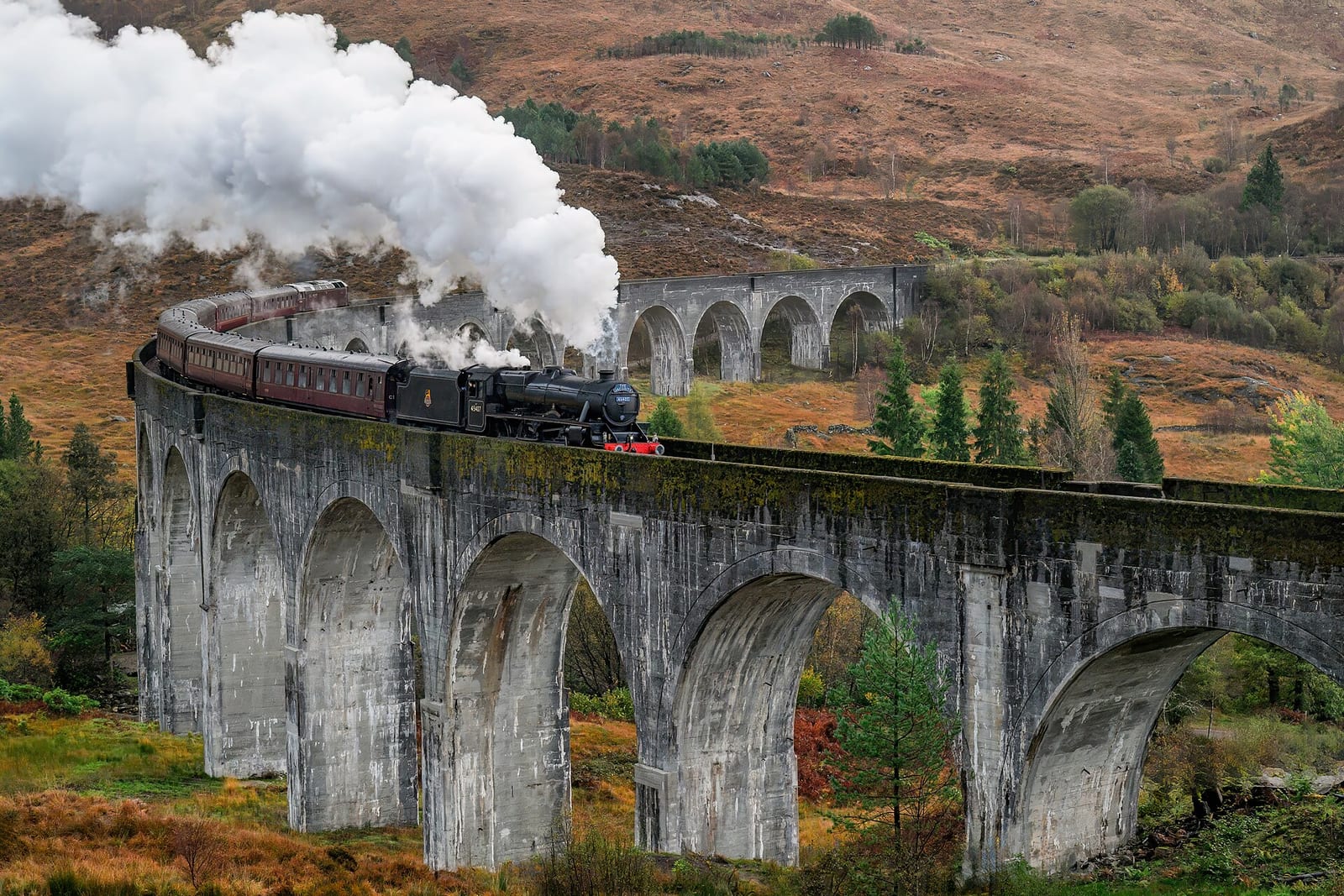
The Jacobite Steam Train
Eric Kilby / Wikimedia Commons · CC BY-SA 4.0
- Distance66 km (41 mi)
- Duration~2 hours each way
- Best seasonJun–Oct
Introduction
You already know this railway, even if you have never set foot in Scotland. A maroon steam train, a plume of smoke, a great curving viaduct high above an empty glen — it is one of the most filmed stretches of line on earth, the road to Hogwarts made real.
But the Jacobite was extraordinary long before a wizard boarded it. In two unhurried hours it runs from Fort William, in the shadow of Ben Nevis, out to the fishing port of Mallaig on the west coast, threading a corner of the Highlands so wild that the railway almost wasn't built at all. There are sea lochs and freshwater lochs, white-sand beaches and brooding mountains, and — the star of the show — the Glenfinnan Viaduct, twenty-one arches sweeping in a slow curve a hundred feet above the ground.
It is hauled by a genuine heritage steam locomotive and made up of old British Railways carriages, so it doesn't just look like a journey from another age — for the length of the West Highland Line, it truly is one. And reaching Fort William is a classic in its own right: by ScotRail from Glasgow over Rannoch Moor, or overnight from London on the Caledonian Sleeper, which arrives in time for the morning steam departure.
The Journey
The Jacobite runs the Mallaig extension of the West Highland Line, 41 miles (66 km) of railway that took the Victorians to the very edge of the country.
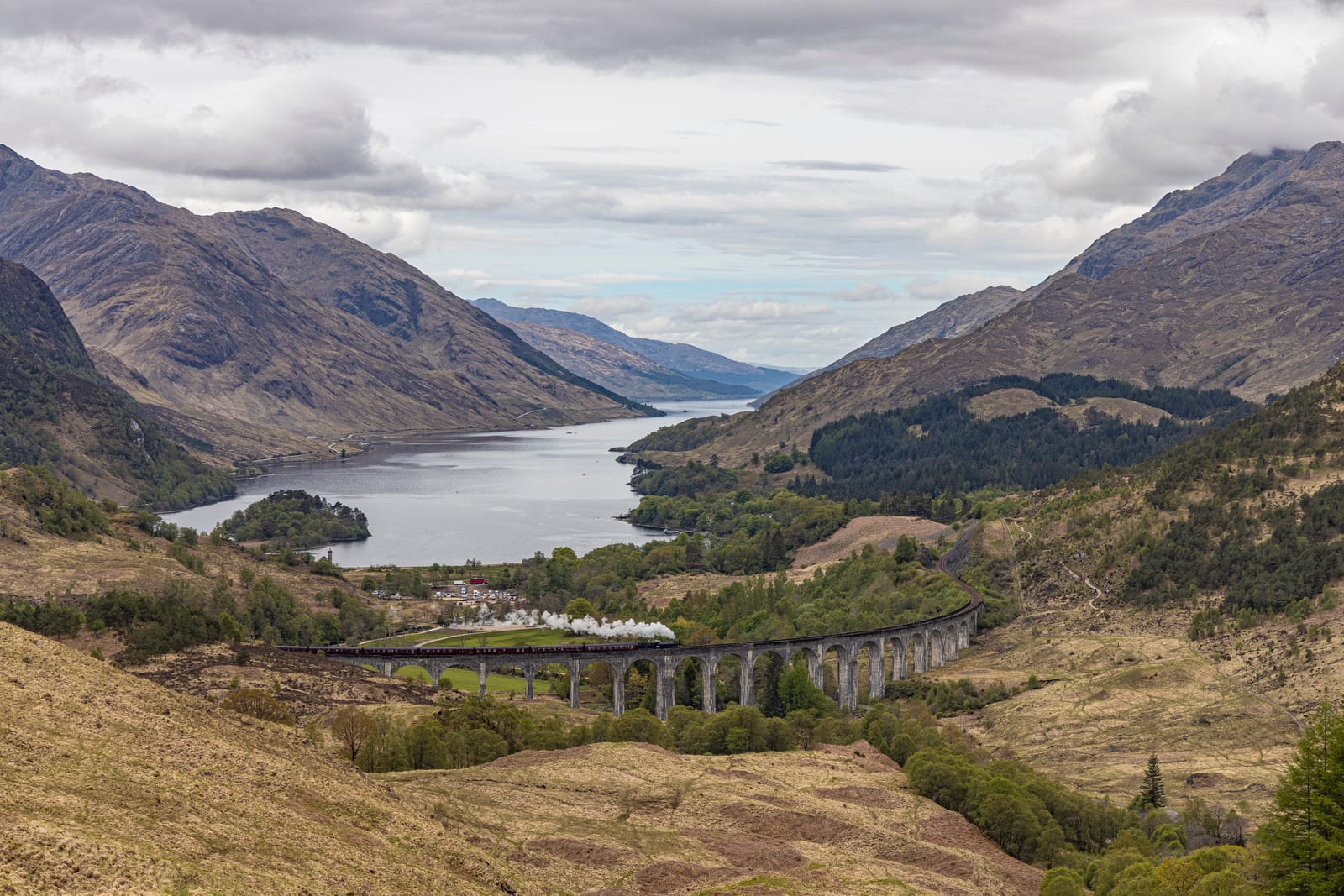
It leaves Fort William — the outdoor capital of the Highlands, beneath Ben Nevis, Britain's highest mountain — and is soon running along the shore of Loch Eil, the water on one side and the hills rising on the other. Then comes the moment everyone waits for. The line swings out onto the Glenfinnan Viaduct, a graceful curve of twenty-one arches carrying the train a hundred feet above the River Finnan, and as it does, Loch Shiel opens up ahead between the mountains, the Glenfinnan Monument standing at its head where Bonnie Prince Charlie raised his standard in 1745.
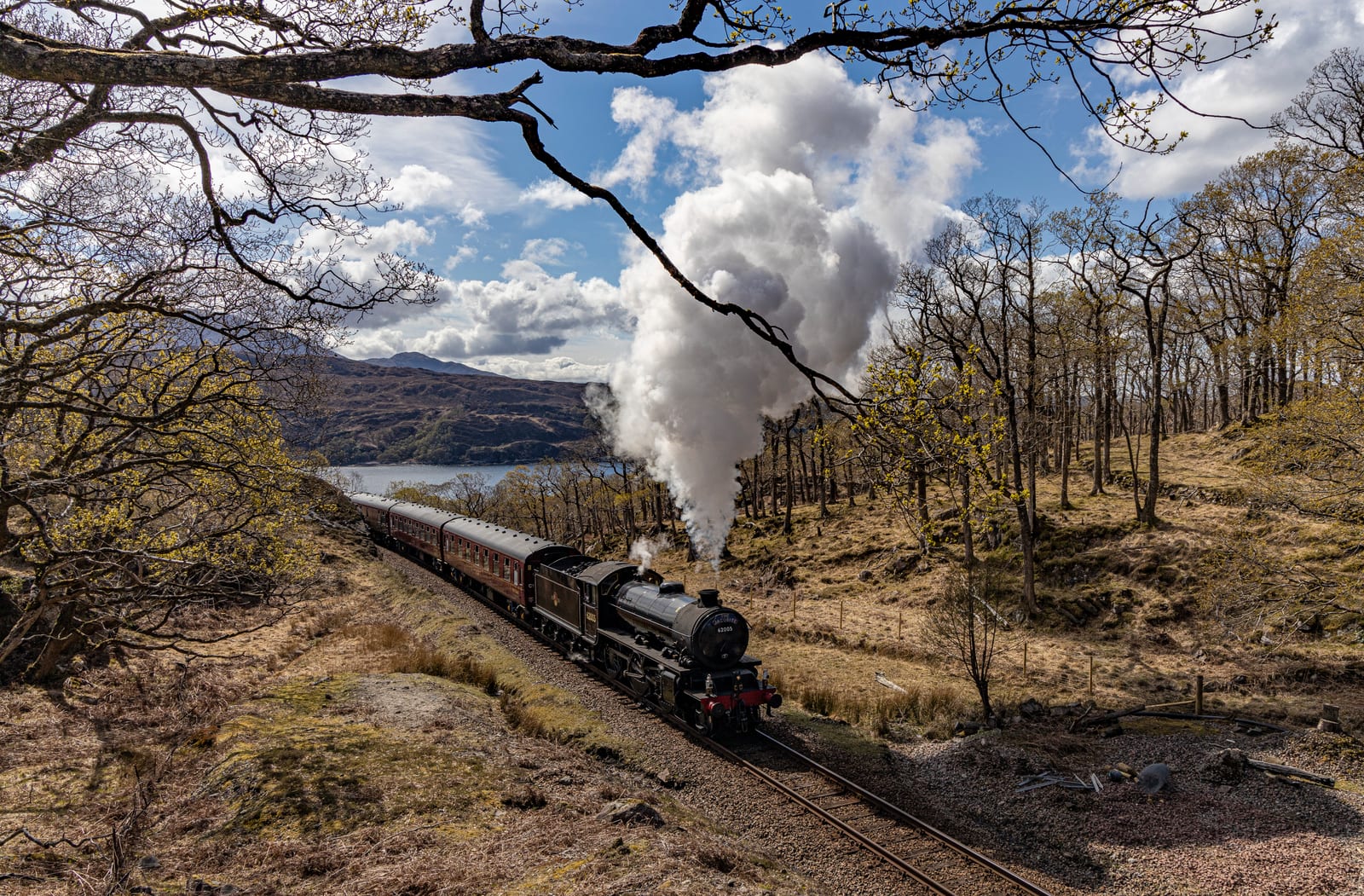
Beyond Glenfinnan the railway turns coastal and, if anything, even more beautiful. It calls at Arisaig, the most westerly mainland railway station in Britain, then runs beside the dazzling white silver sands of Morar — with the Small Isles and the Cuillin of Skye across the water — past Loch Morar, the deepest freshwater loch in Britain, before rolling down into Mallaig, a working fishing harbour where ferries leave for the islands.
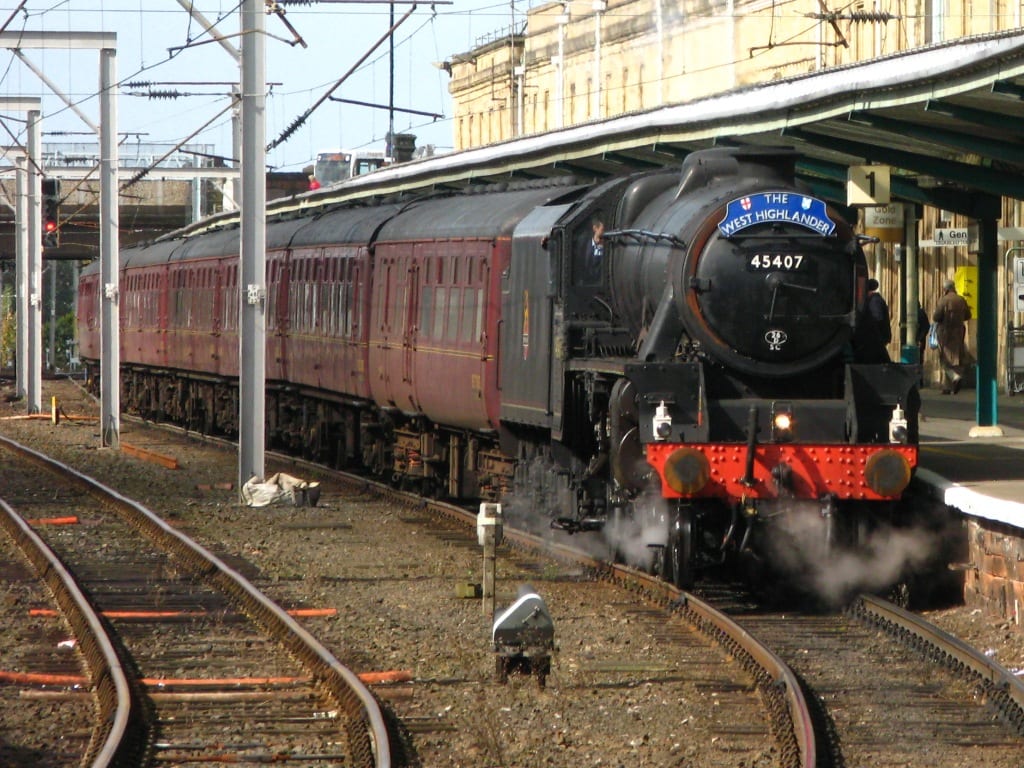
The train itself is part of the magic: a heritage steam locomotive — usually a Stanier "Black Five" or the K1 — at the head of maroon British Railways carriages, whistle echoing off the hillsides. There is roughly an hour and a half at Mallaig before the same glorious run in reverse.
Along the route
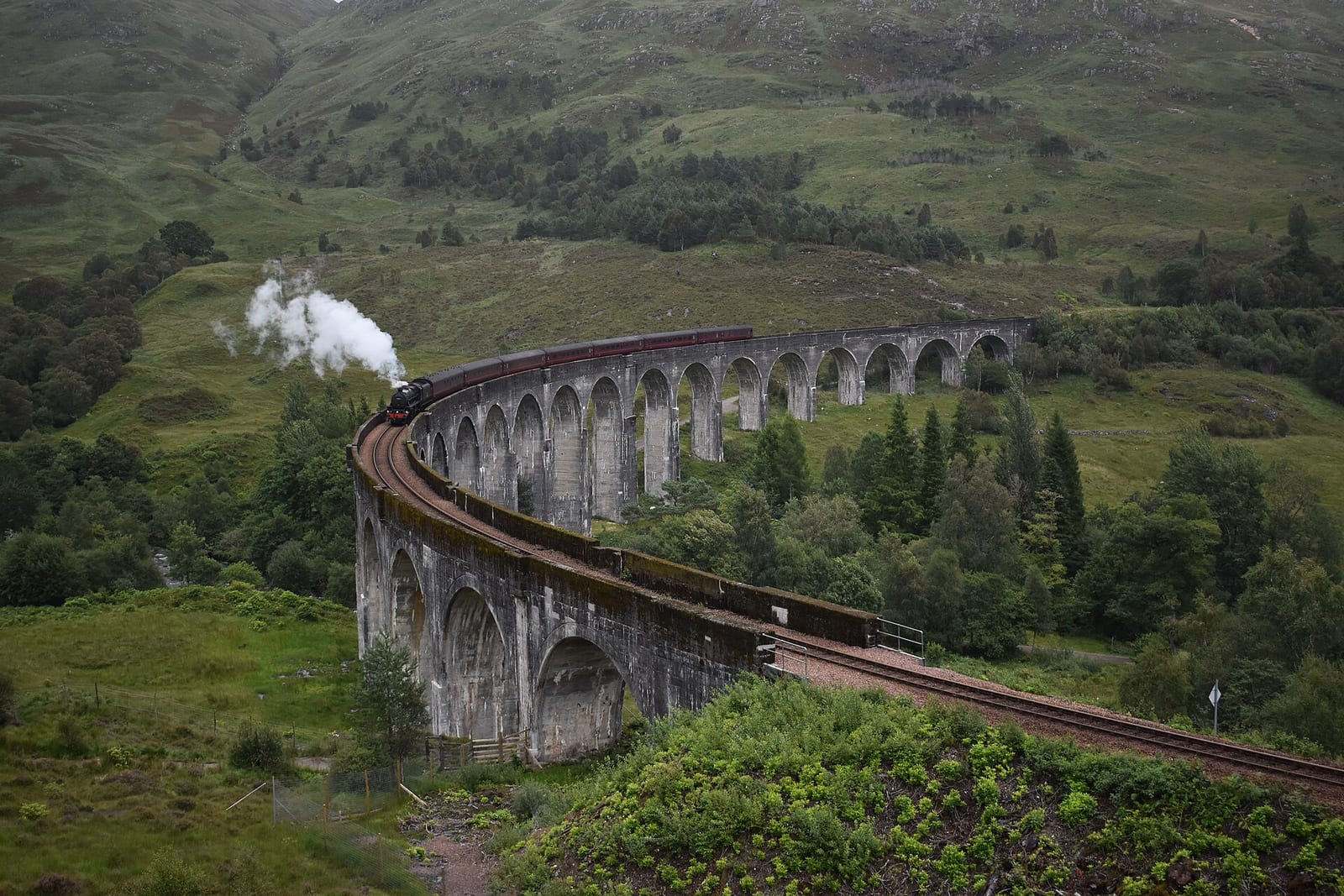
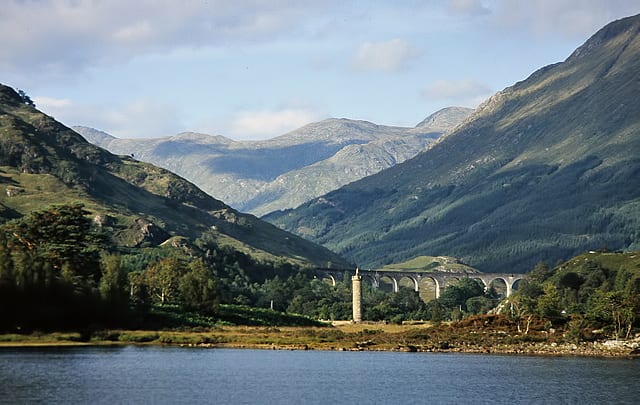
Photo: Dave CollierThe Glenfinnan Viaduct
Twenty-one arches sweeping in a great curve a hundred feet above the glen — the most famous stretch of railway in Britain, and the reason half the train hangs out of the windows with a camera as the engine takes the bend.Walter Baxter / Wikimedia Commons · CC BY-SA 2.0Loch Shiel & Glenfinnan
Just beyond the viaduct, Loch Shiel stretches away between the mountains past the Glenfinnan Monument, raised where Bonnie Prince Charlie first rallied the clans in 1745.Anthony O'Neil / Wikimedia Commons · CC BY-SA 2.0Arisaig & the Silver Sands
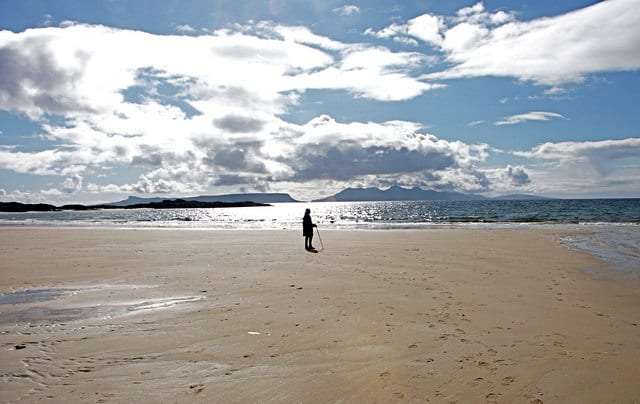
Past Arisaig — Britain's most westerly mainland railway station — the line runs beside the dazzling white beaches of Morar, with the Small Isles and, on a clear day, Skye across the water.A bit of history
Culture & experiences along the way
Geof Sheppard / Wikimedia Commons · CC BY-SA 4.0Riding the Hogwarts Express
This is the line, and the viaduct, that carried Harry and friends to Hogwarts in the films. The Jacobite is steam-hauled by heritage locomotives — Black Fives and the K1 — with British Railways maroon carriages, so the whole thing genuinely looks the part.Tiefenschaerfe / Wikimedia Commons · CC BY-SA 3.0Mallaig & the Isles
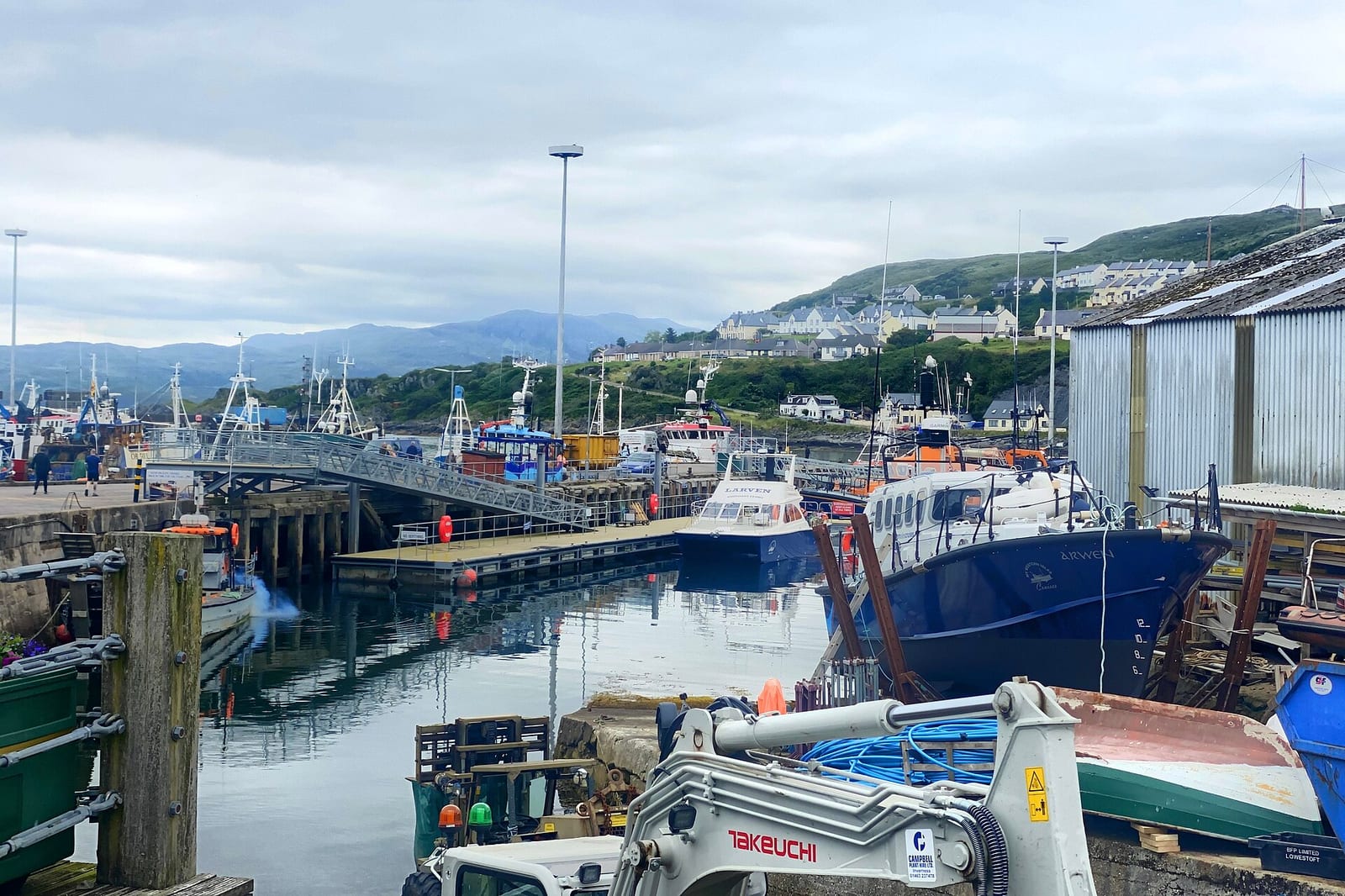
The line ends at Mallaig, a busy little fishing harbour where the day's catch is landed and ferries slip out to Skye and the Small Isles — time for fish and chips on the quay before the return run.Photo: Dave CollierThe West Highland Line
The Mallaig extension is a feat of Victorian engineering through some of Britain's most rugged country — Robert McAlpine, "Concrete Bob", pioneered mass concrete here to carry the railway to the coast.Timetables
The Jacobite is a seasonal service, running spring to autumn only. It is enormously popular, and seats — especially on the side that faces the viaduct — sell out well in advance, so book early.
Two return services run at the height of the season:
| Service | Departs Fort William | Arrives Mallaig | Departs Mallaig | Arrives Fort William |
|---|---|---|---|---|
| Morning | 10:15 | 12:25 | 14:10 | 16:00 |
| Afternoon (summer) | early afternoon | — | late afternoon | early evening |
In 2026 the morning service runs daily from 1 June to 23 October, with the afternoon service added from mid-June to late September. There is around 90 minutes at Mallaig between the outward and return journeys — enough for fish and chips on the quay. Exact times and dates vary by year; always confirm with the operator before you travel.
Prefer not to travel by steam, or the Jacobite is sold out? The same spectacular route is covered daily, year-round, by ordinary ScotRail services between Fort William and Mallaig.
Tickets
The Jacobite is operated by West Coast Railways and booked directly through them. Fares vary by season and class and are best checked live on their site, so we link you straight there rather than quote a figure that may change.
Two classes are offered, and every seat in both looks out on the scenery:
- Standard Class — a reserved seat in a classic British Railways Mark 1 carriage.
- First Class — more space and comfort for the run to the coast, at a premium.
A few practical notes:
- Book early. This is one of the most sought-after train trips in the world, and the coveted viaduct-side seats go first.
- Which side? Heading to Mallaig, the finest views — including the drop from the viaduct down Loch Shiel — are generally on the left.
- Sold out? The daily ScotRail service covers the identical route year-round for a fraction of the price (without the steam and heritage carriages).
Book your tickets
Standard Class
Fort William ⇄ Mallaig
A reserved seat in a British Railways Mark 1 carriage, every one facing the scenery. Book the return, or a single and travel back another way.
Book Tickets (opens in a new tab, on West Coast Railways)via West Coast RailwaysFirst Class
More space, same views
Roomier First Class seating for the two-hour run to the coast. Limited and hugely popular in summer, so book well ahead.
Book Tickets (opens in a new tab, on West Coast Railways)via West Coast RailwaysRail Passes
Content coming soon.
Places to Visit
The Jacobite runs there and back in a day, which is efficient and slightly unfair to the country it passes through. The whole Fort William–Mallaig corridor — the Road to the Isles, by rail or by the parallel road — deserves two or three days rather than five hours of window.
The obvious way to give it that is to ride the steam train one way and come back slowly. The Glenfinnan stop is long enough for the viewpoint but not for the loch or the monument; Morar and Camusdarach, whose white sands stood in for the beach in Local Hero, are barely a glimpse from the carriage; and Mallaig's ferries all leave after the train has turned round. A car, a bike or the ordinary ScotRail service fills in what the excursion cannot.
If you only have the one day, the best use of the layover at Mallaig is lunch on the harbour and the walk up to the viewpoint above the town — and the best use of the Fort William end, before or after, is Glen Nevis.
 Lebeda Karel / Wikimedia Commons · CC BY-SA 4.0 · cropped
Glen Nevis and Steall Falls
The glen that runs in behind Ben Nevis is the best half-day at the Fort William end. From the car park at its head a rough path threads the Nevis Gorge and opens suddenly onto Steall Falls — a 120-metre ribbon down the far wall of the valley, and Scotland's second-highest waterfall. A three-wire bridge crosses the river to the meadow beneath it, for those who fancy it. The John Muir Trust looks after the ground. Peter S / Geograph Britain and Ireland / Wikimedia Commons · CC BY-SA 2.0 · cropped
Neptune's Staircase, Banavie
Barely out of Fort William the train crosses the Caledonian Canal at Banavie, where Thomas Telford built a flight of eight locks between 1803 and 1822 to lift boats 19 metres in one go. It is the longest staircase lock in Britain, and a yacht still takes about ninety minutes to work through it — which was quick compared with the half-day it took before the gates were made hydraulic in 1969. Jo and Steve Turner / Geograph Britain and Ireland / Wikimedia Commons · CC BY-SA 2.0 · cropped
Glenfinnan Station Museum
While everyone else walks up to the viewpoint, the station building itself holds a small and genuinely good museum, open since 1991, on how the Mallaig Extension was built and worked — with the old signal box next door as a hands-on exhibit. Two preserved carriages in the siding do the rest: a Dining Car for lunch, and a 1958 Sleeping Car that is now bunkhouse accommodation for up to ten. MPerkowski / Wikimedia Commons · CC BY-SA 4.0 · cropped
Loch Eilt
Five kilometres long and half a kilometre wide, Loch Eilt is the one to have the camera ready for between Glenfinnan and Lochailort — the railway runs along the south shore, the road along the north, so the train has the better side. The pine-topped island is Eilean na Moine, which served as Dumbledore's grave in the Potter films. Local Hero filmed here too, back in 1983. Gordon Hatton / Geograph Britain and Ireland / Wikimedia Commons · CC BY-SA 2.0 · cropped
Arisaig
The Gaelic name means "safe bay", and the sheltered anchorage is still full of masts. It is a good place to stop on the coast road between the beaches, but it has a stranger history too: Arisaig House was headquarters of the Special Operations Executive's Scottish section in the Second World War, and agents bound for occupied Europe trained in these hills. The Land, Sea and Islands Centre in the village tells that story. Jim Barton / Geograph Britain and Ireland / Wikimedia Commons · CC BY-SA 2.0 · cropped
The Small Isles
From Mallaig the ferries run out to Rum, Eigg, Muck and Canna — and Eigg is the one with the story. Its 95 residents bought the island themselves in 1997, ending centuries of absentee landlords, and now run a grid that is about 98 per cent renewable from hydro, wind and sun. Above the pier rises An Sgurr, 393 metres of pitchstone and the largest ridge of its kind in Britain.Where to Sleep
Because the Jacobite is a day return, most travellers base themselves at one end and ride out and back. Both towns make a good base, and the villages between are quietly special.
- Fort William — the practical choice, with the widest range of hotels, guesthouses and B&Bs, plus the grand Inverlochy Castle just outside town for a splurge. Handy for the morning departure.
- Mallaig — smaller and salty, with harbour-front inns and guesthouses; stay here if you want to catch an early island ferry or simply wake to the sound of the fishing boats.
- Glenfinnan — the tiny Glenfinnan House Hotel and the famous Glenfinnan Station Museum sleeping car put you right by the viaduct.
- Arisaig & Morar — beachside hotels and self-catering among the silver sands, for those who'd rather trade convenience for one of the finest coastlines in Britain.
Wherever you stay, book ahead in summer — the whole Road to the Isles fills up while the Jacobite is running.
Comments
Facebook comments
Facebook will see your IP address and can set cookies. If you are signed in to Facebook it can connect this visit to your account.
Loads Facebook (Meta) content from now on, across the site. Undo this at any time.