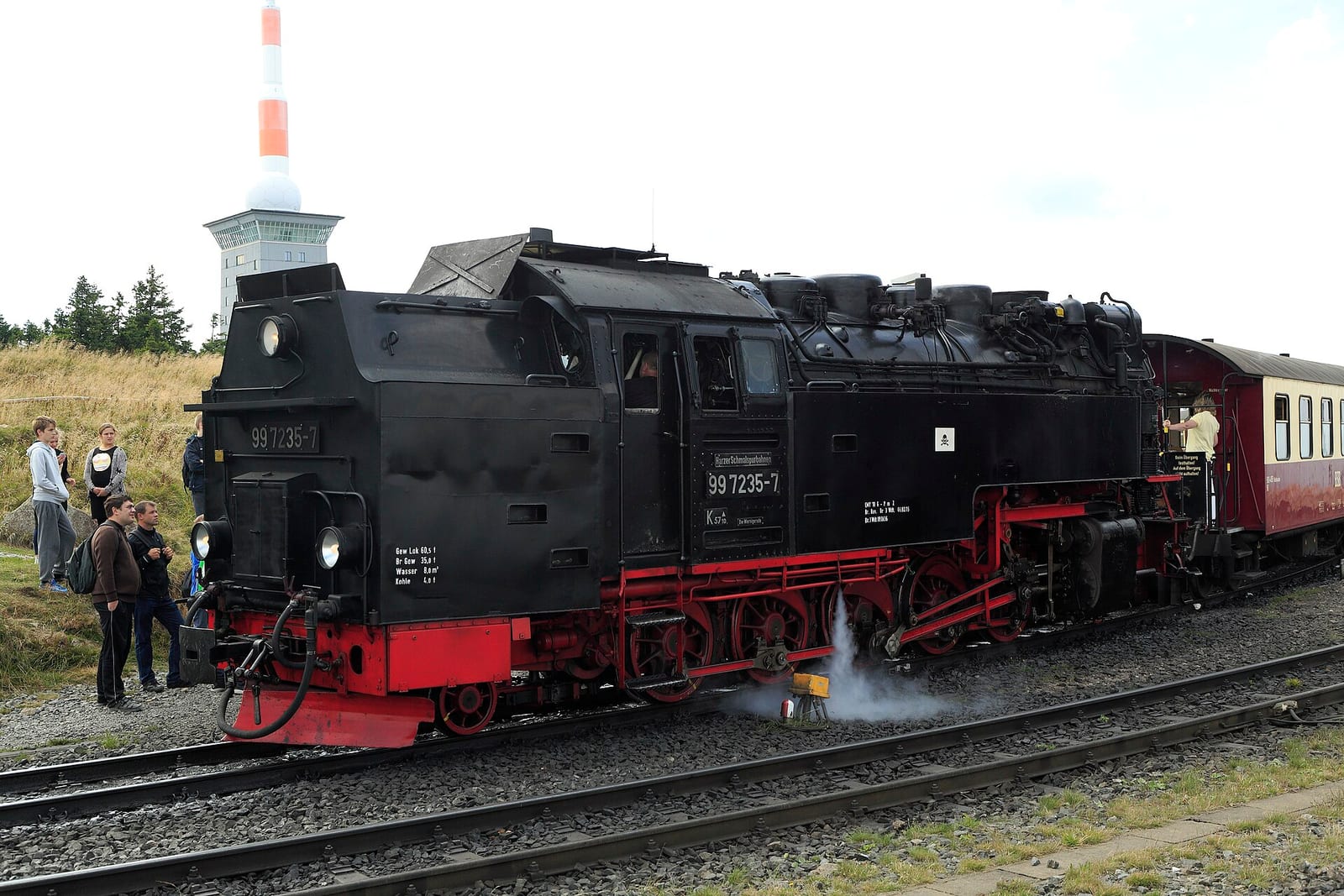
Harz Steam Railway
Falk2 / Wikimedia Commons · CC BY-SA 4.0
- Distance34 km (to the Brocken)
- DurationAbout 1¾ hours
- Best seasonYear-round
Introduction
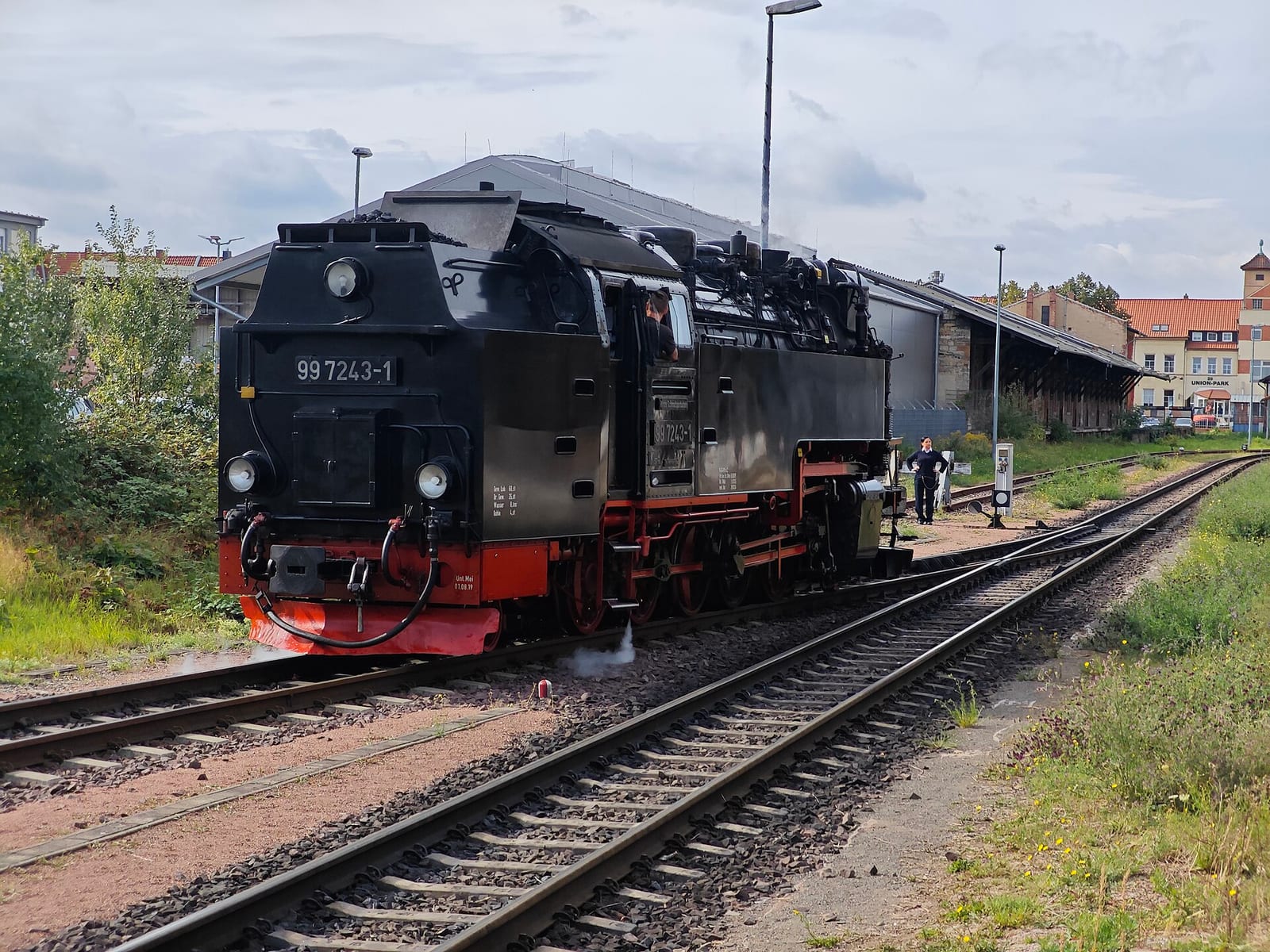
In the forested hills of central Germany, the age of steam never quite ended. The Harzer Schmalspurbahnen — the Harz Narrow-Gauge Railways — still run vintage steam locomotives to a daily timetable, all year round, across the largest steam-worked narrow-gauge network in the country.
The star of the show is the climb to the Brocken. At 1,141 metres it is the highest point in the Harz and in all of northern Germany, and the Brockenbahn spirals up to it through dark spruce forest behind a hard-puffing engine, emerging at a bleak, wind-scoured summit that is wrapped in cloud some 300 days a year. It is a mountain steeped in legend — the gathering place of witches on Walpurgisnacht, and the setting for the witches' sabbath in Goethe's Faust.
The network fans out from the half-timbered town of Wernigerode, reaching south across the hills to Nordhausen and to the medieval streets of Quedlinburg. Ride it in summer sun or winter snow and it feels like time travel — real working steam through a storybook German landscape.
The Journey
The classic run is the Brockenbahn, from Wernigerode up to the summit — about 34 kilometres that take the best part of two hours, because the little train has a mountain to climb.
It sets off from Wernigerode, whose half-timbered old town and hilltop castle are worth a day in themselves. The train potters out through the suburbs and into the woods, climbing steadily to the junction at Drei Annen Hohne, where the Brocken line branches off from the cross-Harz route. From here the real work begins: the engine digs in, the gradient steepens, and the line begins to spiral, curving around the mountain in a great loop to gain height.
Past the resort village of Schierke the trees thin, the weather closes in — the Brocken makes its own — and the train hauls itself up onto the bare, boulder-strewn dome of the summit. On a clear day the view runs for a hundred kilometres; more often you step out into swirling cloud, which only adds to the mountain's witchy reputation. Up top there are gardens, a museum in the old Cold War listening station, and hot soup against the wind before the run back down.
Beyond the Brocken, the wider network rewards exploration: the Harzquerbahn grinds south across the hills to Nordhausen, and the Selketalbahn wanders through quiet valleys toward Quedlinburg, one of the best-preserved medieval towns in Germany. A day rover ticket lets you hop between them, steam train to steam train.
Along the route
Falk2 / Wikimedia Commons · CC BY-SA 4.0Steam to the Brocken
The climax is the climb to the Brocken — at 1,141 m the highest point in northern Germany — on the Brockenbahn, spiralling up through the trees behind a hard-working steam engine to a summit that is wrapped in cloud some 300 days a year.Leonhard Lenz / Wikimedia Commons · CC BY-SA 4.0Real working steam
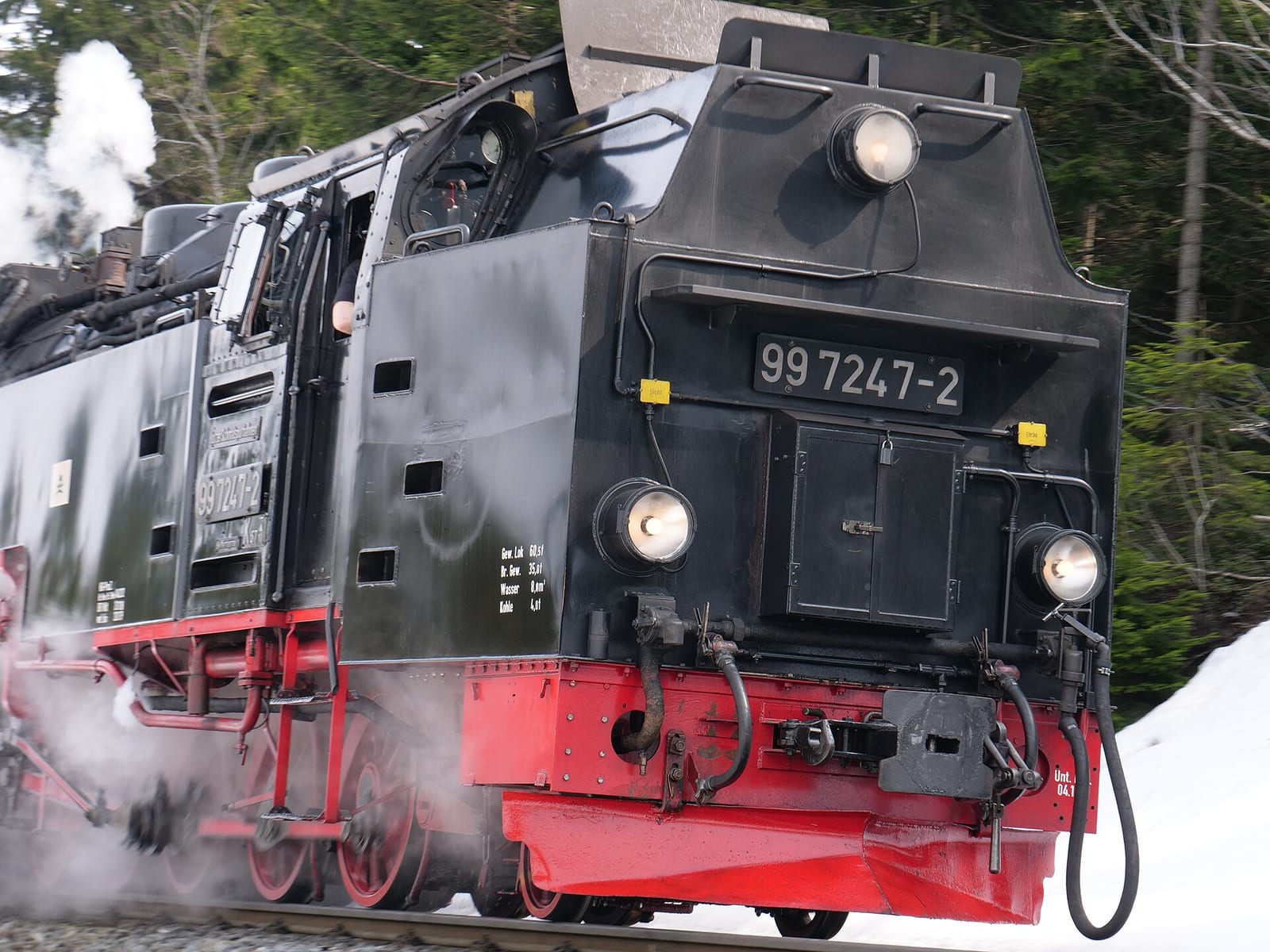
This is no weekend heritage line: the Harz network runs vintage steam locomotives to a daily timetable all year round, snow or shine — the largest steam-worked narrow-gauge system in Germany, and one of the last of its kind in Europe.Michielverbeek / Wikimedia Commons · CC BY-SA 4.0Fairy-tale Harz towns
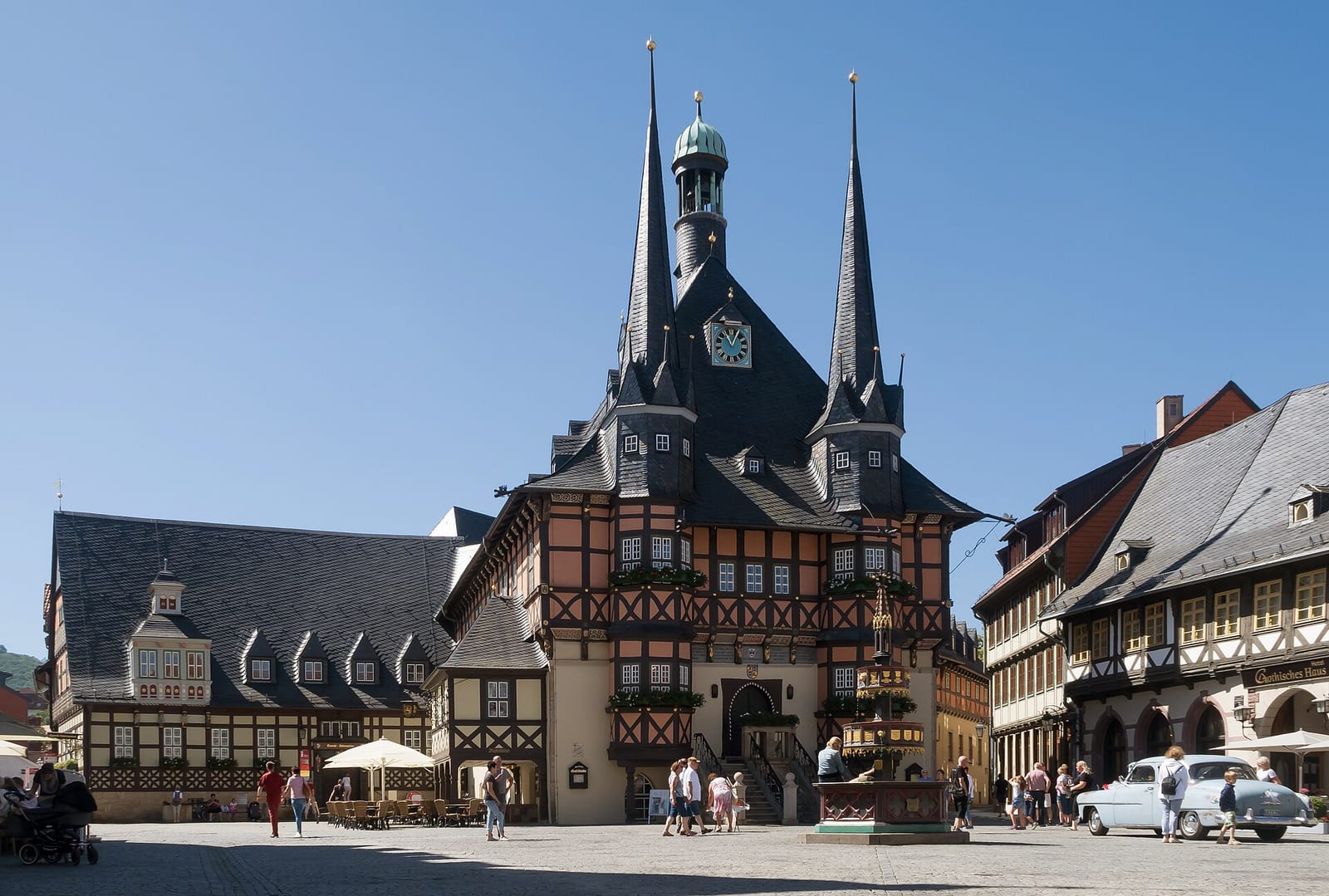
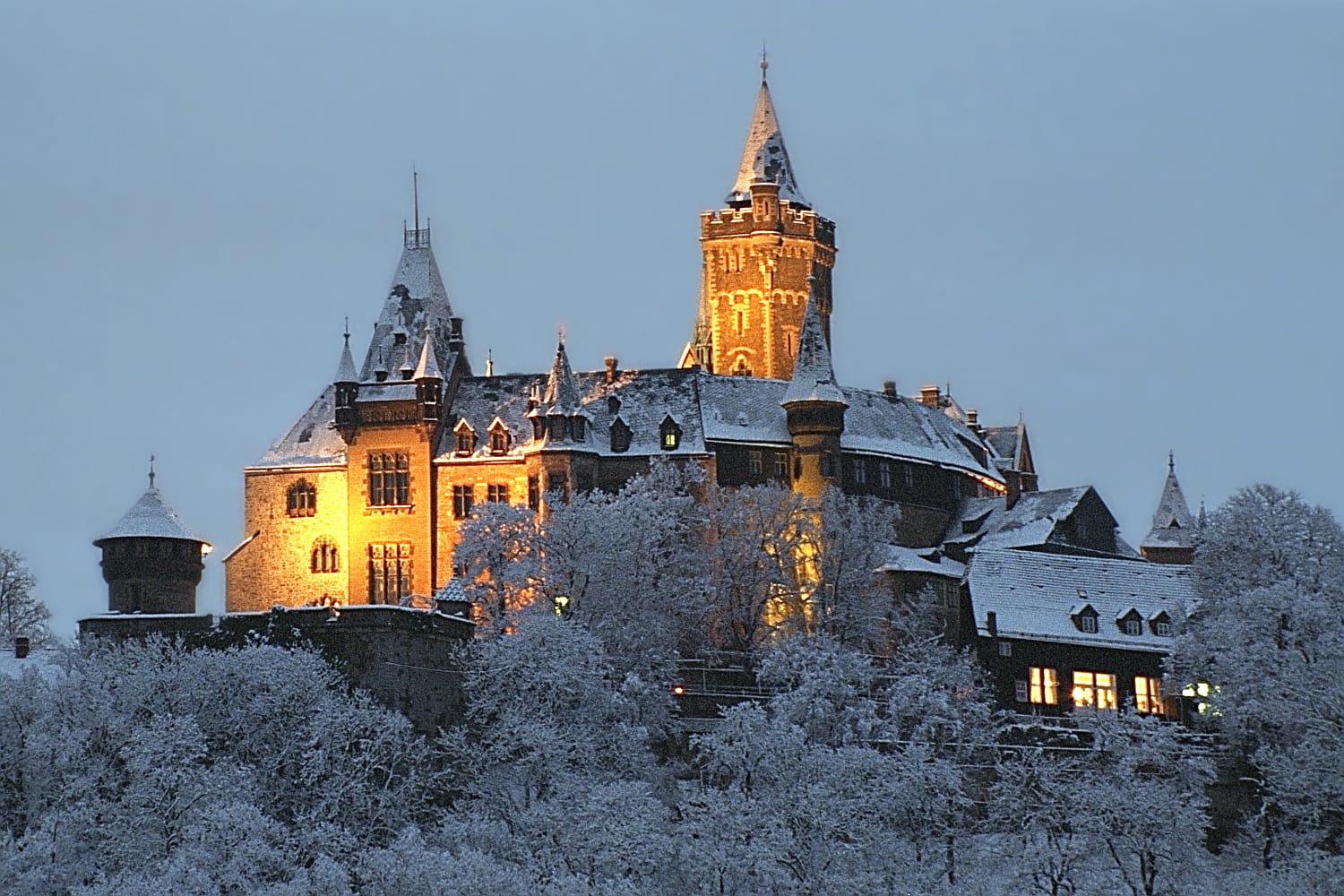
The line is bookended by two of Germany's prettiest towns — half-timbered Wernigerode below its hilltop castle, and, on the network's southern arm, the UNESCO-listed medieval maze of Quedlinburg.A bit of history
Culture & experiences along the way
Joerg Fuhrmann / Wikimedia Commons · CC BY-SA 4.0Ride behind a steam engine
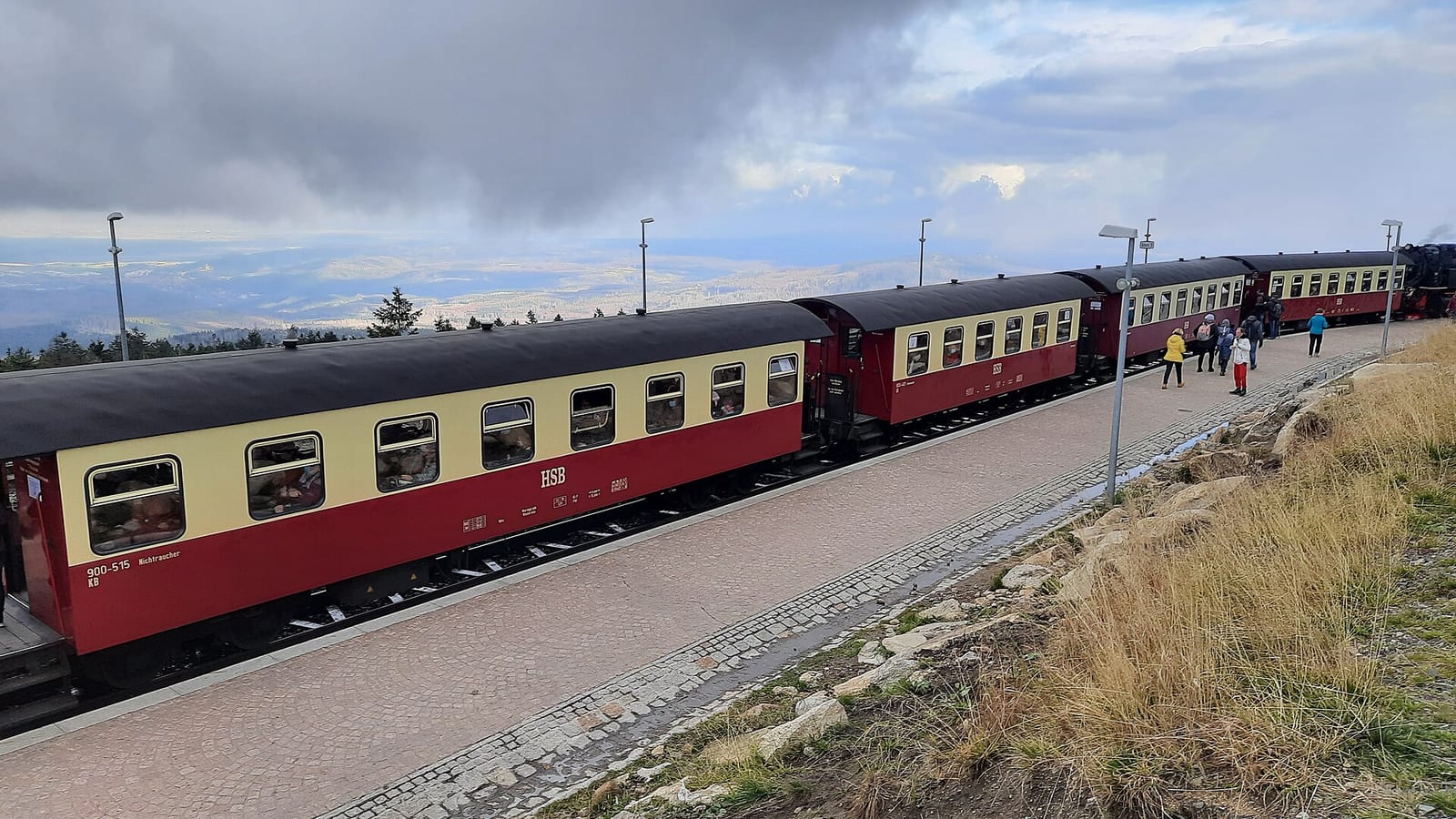
Settle into a vintage carriage, drop the window, and listen to the locomotive bark as it lifts the train up the gradient — coal smoke, steam and the smell of a bygone age, on an everyday scheduled train.Christian Alexander Otto / Wikimedia Commons · CC BY 4.0The witches' mountain
The Brocken has been the legendary gathering place of witches for centuries — the setting for the Walpurgis Night revels in Goethe's "Faust", still celebrated across the Harz every 30 April. Watch, too, for the eerie "Brocken spectre" in the summit mists.Andreas Tille / Wikimedia Commons · CC BY-SA 4.0Half-timbered Wernigerode
Base yourself in Wernigerode, the "colourful town in the Harz" — a storybook tangle of half-timbered houses beneath a romantic hilltop castle, and the northern terminus where the Brocken trains steam out each morning.Timetables
The Harz railways are a scheduled, year-round steam operation — not a summer-only heritage line — run by the HSB. Steam hauls most Brocken trains; some services on the other lines use historic diesel railbuses. About four steam trains a day climb from Wernigerode to the Brocken summit, taking about 1 hour 36 minutes each way (via Drei Annen Hohne and Schierke).
The three lines:
| Line | Route | Notes |
|---|---|---|
| Brockenbahn | Wernigerode ⇄ Brocken | The steam climb to the 1,141 m summit; ~1 h 36 each way, ~4 a day |
| Harzquerbahn | Wernigerode ⇄ Nordhausen | Across the Harz; connects with the Brocken line |
| Selketalbahn | Quedlinburg / Gernrode ⇄ Hasselfelde–Eisfelder Talmühle | Quiet valleys, the southern arm |
Good to know:
- The Brocken train runs daily, all year — including through winter snow, a spectacle in itself. There are separate summer and winter timetables (the summer service runs from early March), so check the current one.
- Reserve in high season — the Brocken is hugely popular in summer, at weekends and around Walpurgisnacht (30 April).
- Get a rover for the network if you want more than the Brocken: a day ticket covers all three lines.
- Dress for the summit — cold, windy and often foggy on top even in summer.
Frequency and journey time as of the 2026 timetable. Confirm the current summer/winter schedule with the operator — see the Tickets section below.
Tickets
Tickets are bought directly from the Harzer Schmalspurbahnen (HSB) — at the station, or online in advance, which is wise for the Brocken.
Two ways to ride:
- Brocken return — the headline trip: a steam-hauled return from Wernigerode up to the summit and back. The most popular train on the network, so reserve ahead in summer and around Walpurgisnacht.
- Network day ticket — a rover over the whole 140 km system (Brockenbahn, Harzquerbahn and Selketalbahn), ideal for combining the summit with the Harz towns and a bit of steam-train-hopping.
A few pointers:
- Fares are seasonal and change, so we point you to the HSB for the live price rather than quote a figure that will date.
- The Brocken sells out on fine summer days and holidays — book a specific departure if you can.
- Combine train and trail. Many walk one way (the Goetheweg path shadows the line to the summit) and take the steam train the other — a wonderful way to do the Brocken.
- Bring cash for the summit soup and the small stations, and warm clothes for the top.
Book your tickets
Brocken return
Wernigerode ⇄ the Brocken
The headline trip: a return ticket on the steam-hauled Brockenbahn from Wernigerode up to the summit and back. Booked directly with the HSB; the summit train is popular, so it's worth reserving ahead in high season.
Book Tickets (opens in a new tab, on Harzer Schmalspurbahnen)via Harzer SchmalspurbahnenNetwork day ticket
All three Harz lines
A day rover over the whole 140 km HSB network — the Brockenbahn, the Harzquerbahn to Nordhausen and the Selketalbahn around Quedlinburg — for hopping between steam trains and Harz towns at your own pace.
Book Tickets (opens in a new tab, on Harzer Schmalspurbahnen)via Harzer SchmalspurbahnenRail Passes
There is one thing to know here, and it decides everything: the national ticket that covers the rest of the Harz network stops at the bottom of the Brocken climb.
The Deutschland-Ticket, and where it stops
The Harzer Schmalspurbahnen takes part in the Deutschland-Ticket, and in the operator's own words:
Das Deutschlandticket-Abo gilt in unseren regulären Zügen auf dem gesamten HSB-Streckennetz, ausgenommen zwischen Drei Annen Hohne – Brocken.
The Deutschland-Ticket subscription is valid on our scheduled trains across the whole HSB network, except between Drei Annen Hohne and the Brocken.
So for €63 a month you can ride the Harzquerbahn from Wernigerode to Nordhausen, the whole Selketalbahn, and up as far as Drei Annen Hohne — and then you buy a Brocken ticket for the last, best 19 kilometres. The pass gets you to the foot of the mountain and no further.
That is not unreasonable. The Brockenbahn is the section everyone comes for, it is worked by steam, and it is priced accordingly under the railway's own Brockentarif.
⚠️ The Deutschland-Ticket is subscription-only, digital and personal — it carries your name and date of birth, is not transferable, and cannot be bought as a one-off for a day out. Turning up at Wernigerode hoping to buy one is not a plan. HSB sells the subscription itself, though at the time of writing new sign-ups through HSB were suspended for technical reasons, with existing subscribers unaffected.
Interrail and Eurail
Neither is valid on the HSB. The railway itself publishes nothing about them — its tariff conditions and fares pages mention no pass at all — but the answer comes from the other end. Interrail's coverage table for Germany covers DB and "all other Regional carriers", and its excluded column adds a line that decides every case it has not named: anything else falls to the list of German railway companies the table links. That list is closed, it runs to some fifty operators, and the Harzer Schmalspurbahnen is not among them.
HSB's own fares are therefore payable in full. There is no pass-holder rate to ask for, and nothing that can be added to a pass at the counter.
⭐ A pass does get you to the railway. Wernigerode, Nordhausen and Quedlinburg are all on the national network and all covered by Interrail and Eurail in the ordinary way, so the approach costs nothing extra.
Is a pass worth it for this journey?
No pass will pay for the Brocken. The operator's own return fare to the summit is the figure to plan around, and anything else a ticket happens to cover is a bonus on top of it.
The Deutschland-Ticket is worth carrying if you are spending a week in the Harz: it makes every other HSB line, and the buses between the towns, free at the point of use, and leaves you paying only for the mountain.
Deutschland-Ticket conditions from the operator, Harzer Schmalspurbahnen GmbH, and pass coverage from Interrail's published list of railway companies, August 2026.
Places to Visit
The Harz packs a lot of storybook Germany into a small area, and the railway links much of it. A day rover ticket lets you hop between the places below, steam train to steam train.
 Markscheider / Wikimedia Commons · CC BY 3.0 · cropped
Wernigerode
The "colourful town in the Harz" and the northern end of the Brocken line, where the steam trains leave from each morning. A tangle of half-timbered streets runs back from an ornately carved town hall, and a romantic hilltop castle looks down on the lot of it from its wooded ridge. Worth a day in its own right, not just a night before the climb. Lapplaender / Wikimedia Commons · CC BY-SA 3.0 de · cropped
The Brocken
At 1,141 metres the highest point in the Harz and in all of northern Germany, and bare and boulder-strewn where the trees give out. The Brockenhaus museum occupies the old Cold War listening station beside the transmitter mast, and there is a garden of hardy mountain plants. The summit is wrapped in cloud some 300 days a year — but on the days it lifts, the view runs for a hundred kilometres. C. Löser / Wikimedia Commons · CC BY 3.0 de · cropped
Schierke
The last village before the summit, tucked in the spruce forest on the steepest part of the climb, with a Kurpark along the Kalte Bode and walking trails running straight off the edge of it. It is the traditional starting point for the Walpurgisnacht witches' celebrations on 30 April, and the closest bed to the Brocken for an early start. Reinhard Kirchner / Wikimedia Commons · CC BY-SA 3.0 · cropped
Quedlinburg
On the network's southern arm, and one of the loveliest medieval towns in Germany: over two thousand half-timbered houses spanning eight centuries, which is why UNESCO listed the whole old town in 1994. The Romanesque collegiate church of St. Servatius crowns the castle hill above it, with an Ottonian treasury inside. Gottfried Hoffmann / Wikimedia Commons · CC BY 3.0 · cropped
Thale & the Bodetal
The Bode has cut the deepest gorge in the Harz here, and the crags on either rim are soaked in legend — the Rosstrappe with its hoofprint in the rock, and the Hexentanzplatz, the "witches' dance floor", across the chasm. A chairlift climbs to the first and a cable car to the second, so you can look at each from the other. Vincent Eisfeld / Wikimedia Commons · CC BY-SA 4.0 · cropped
Nordhausen
The southern end of the Harzquerbahn, reached after the long grind across the hills. The old town keeps pockets of half-timbering and cobbled lanes around the cathedral, and the railway does something found almost nowhere else: because the city tramway is metre gauge too, hybrid trams run out of the streets and onto the Harz railway towards Ilfeld — an arrangement in service since 2004 and known as the "Nordhäuser Modell".Where to Sleep
The Harz is compact, so most people base themselves in one of the pretty towns and make day trips by steam train.
- Wernigerode — the best base for the Brocken: characterful hotels and guesthouses among the half-timbered streets, and the Brocken trains steaming out from the station each morning.
- Schierke — higher up the mountain and closer to the summit, a quiet alpine-style village good for walkers and for an early start on the Brocken.
- Quedlinburg — worth a night or two of its own at the southern end, sleeping among the medieval lanes of a UNESCO town.
- On the Brocken — there's a summit guesthouse for those who want to watch the sun set and rise above the cloud, though most visit for the day.
The Harz is busy in the summer walking season, over Christmas-market weekends, and especially around Walpurgisnacht (30 April), when the whole region celebrates its witches — book well ahead for those dates. Snow is common in winter, when the steam trains look their most magical.
Comments
Facebook comments
Facebook will see your IP address and can set cookies. If you are signed in to Facebook it can connect this visit to your account.
Loads Facebook (Meta) content from now on, across the site. Undo this at any time.