Furka Steam Railway
Markus Giger / Wikimedia Commons · CC BY-SA 4.0
- Distance17.6 km
- Duration2 h 15 up · 2 h 25 down
- Best season18 June to 27 September 2026, Thursday to Sunday; no service at all outside the season
Introduction
Most railways are built to stay where they are put. Once a year, this one is taken apart.
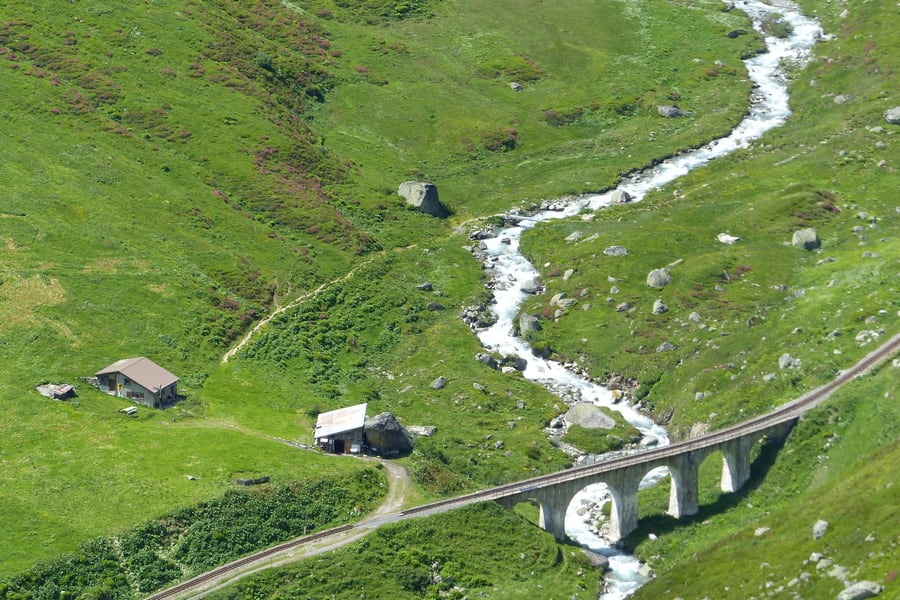
Somewhere above Realp, on a slope where several avalanches come down every winter, the Furka mountain line crosses the Steffenbach on a steel bridge thirty-six metres long and eighteen above the stream. Every autumn that bridge is folded up and laid on the ground out of the avalanche path; every spring it is winched back out and bolted together again, and until it is, there is no railway. It has worked that way since 25 August 1925, and the volunteers who run the line do it with two winches, a few blocks and pulleys, and a day's work. That is the character of the whole thing: seventeen and a half kilometres from Realp in Uri over the shoulder of the Furka pass at 2,160 metres and down to Oberwald in the Valais — the highest place a railway crosses the Alps in Switzerland, the longest line in the country with no wires over it, and half of it rack.
For fifty-five years this was a scheduled railway, and a problem the whole time: shut for seven months a year, the overhead dismantled each autumn, the tunnel portals closed with gates. When the Furka base tunnel opened in 1982 the mountain line was no longer needed and Swiss law required it to be pulled up. Enthusiasts stopped that, and then spent twenty-seven years putting the railway back, reaching Oberwald again on 12 August 2010. It runs from mid-June to late September behind locomotives built in Winterthur before the First World War, four of which spent forty-three years in Vietnam and were shipped home in 1990. Some five hundred and twenty volunteers keep it going with no regular public subsidy, twenty of them spending three to four weeks each spring digging the line out of the snow and rebuilding that bridge.
The Journey
The DFB station at Realp sits at the western end of the village, a seven-minute walk from the Matterhorn Gotthard Bahn platforms and connected to them by a single shunting spur. It is the headquarters of the railway: ticket office, souvenir shop, café, and behind them the depot where the locomotives are lit. Steam is raised long before the first train, because the climb starts almost immediately.
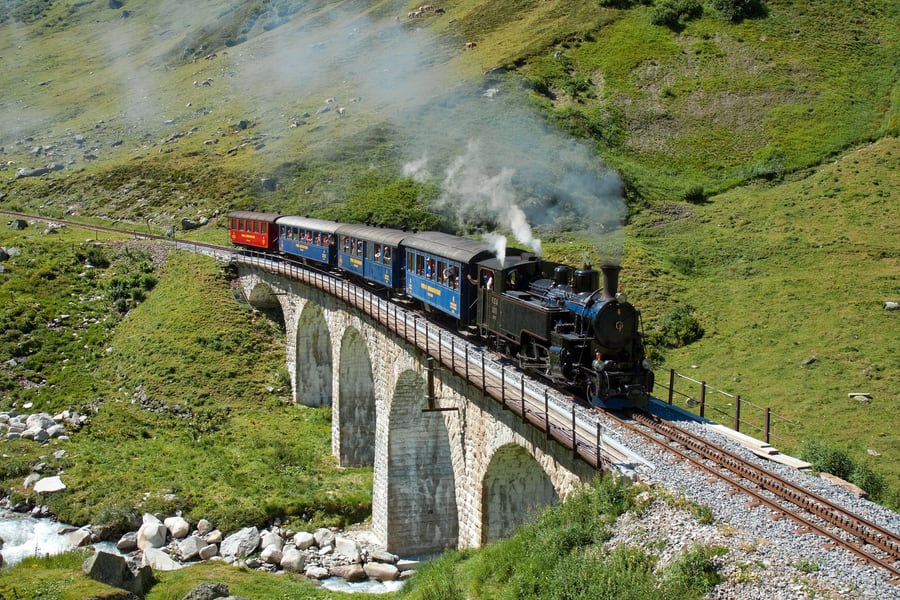
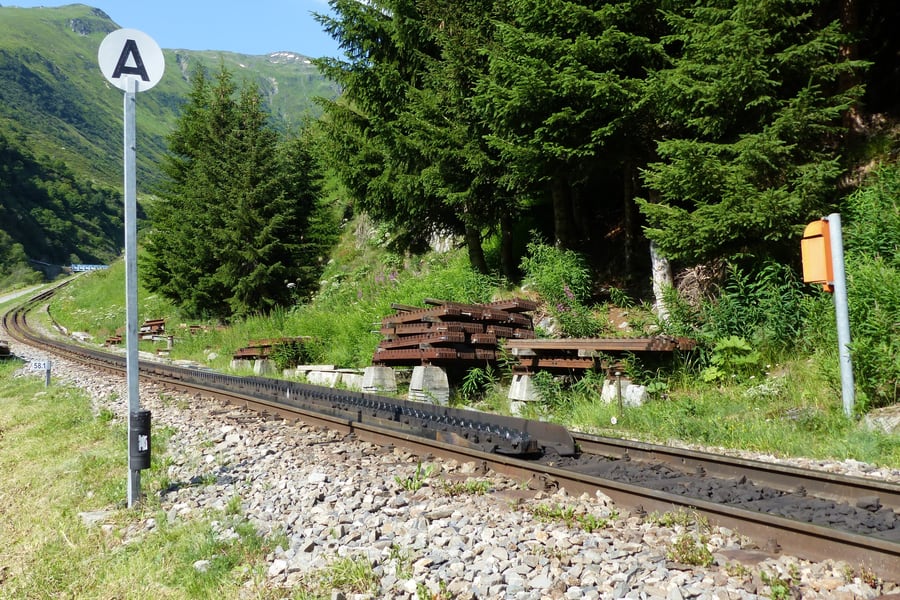
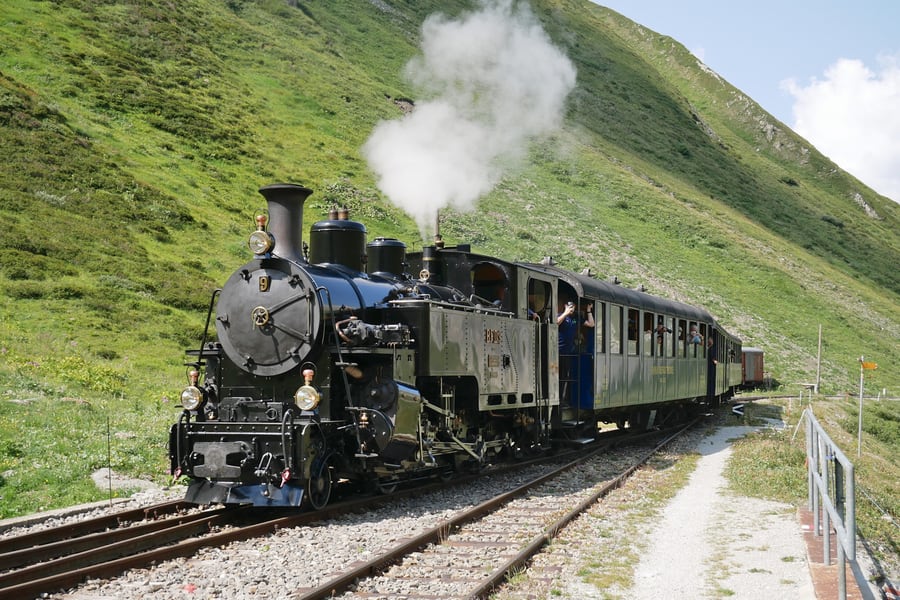
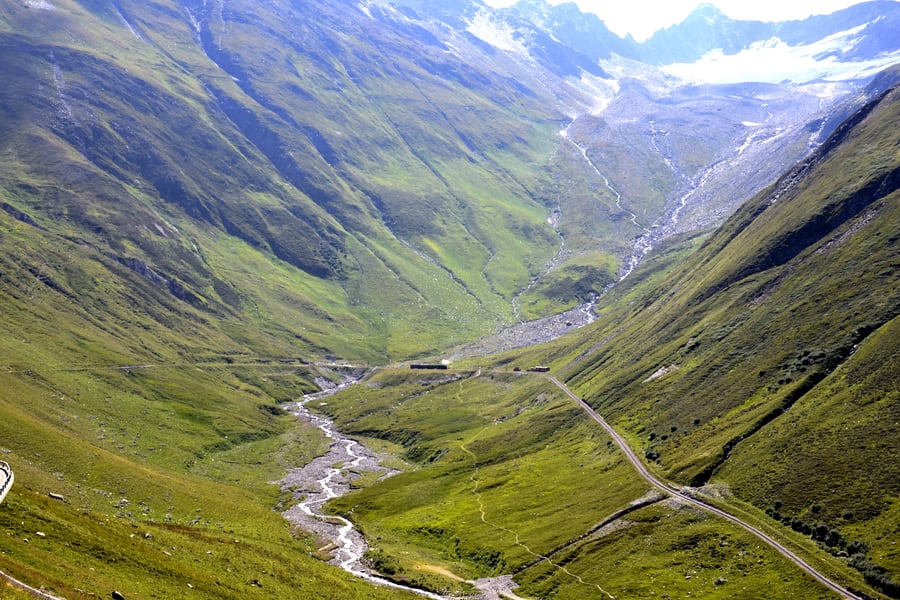
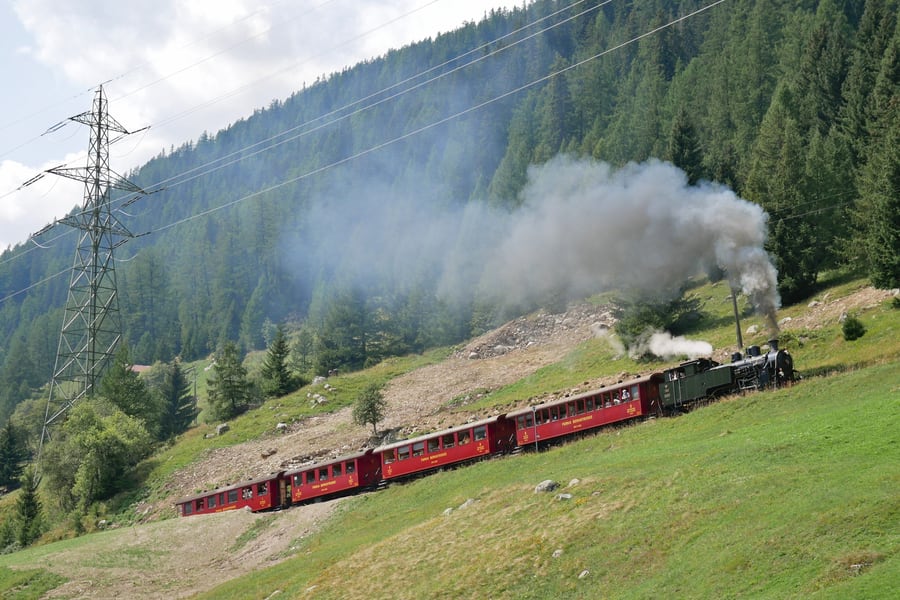
The line follows the Furkareuss upstream, west, on adhesion at first. Within a couple of kilometres the valley narrows into a gorge and the rack begins — Abt system, twin racks, the same pattern the Furka-Oberalp used. From here to the summit the gradient is 110 parts in a thousand almost without relief. The train slows to a walking pace and stays there, and the exhaust becomes the loudest thing in the valley.
The bridge that spends the winter on the ground
About two kilometres out, at 1,765 metres, the line reaches the Steffenbach. A stone viaduct was built here between 1912 and 1914 and destroyed by an avalanche in May 1916, before a single train had crossed it. What replaced it, nine years later, is the reason this railway is remembered.
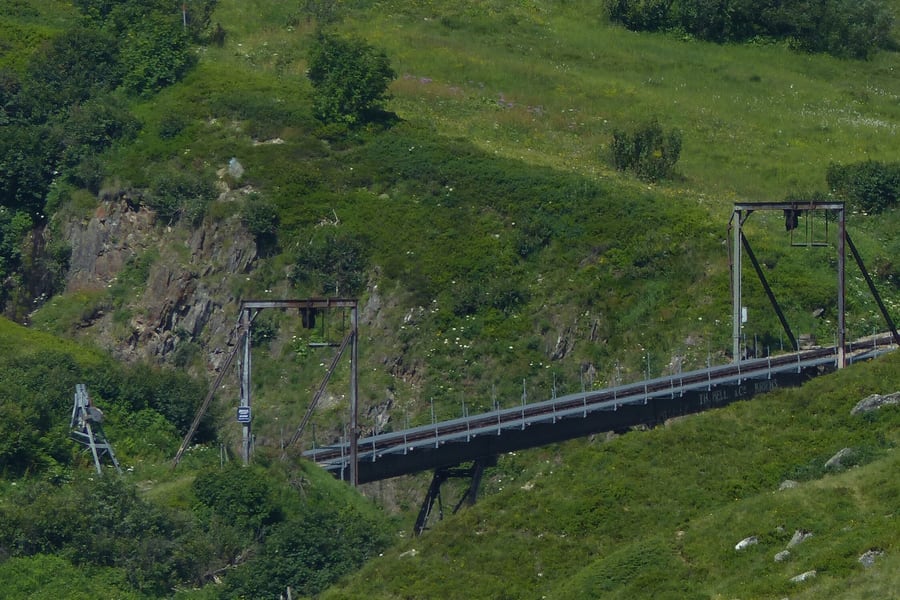
Theodor Bell & Cie of Kriens delivered a bridge in three pieces — 11.65 metres on the Furka side, 13.29 in the middle, 11.30 on the Realp side, 36.24 metres in total, thirty-two tonnes of steel, carried on inclined struts hinged at the abutments and laid at the full 110 ‰ of the adjoining track. In autumn the middle span is lowered until it hangs from the downhill abutment, and the two outer spans are lifted and drawn outwards until their struts fold flat against the bridgeheads. A masonry ledge shelters the hanging middle section from what comes down the gully. In spring the sequence runs backwards. No crane is involved: two winches, two fixed erection frames that stay in place all year, a movable trestle and some pulleys. The idea came from Erminio Bernasconi, chief engineer of the Rhaetian Railway, and the DFB's volunteers first re-erected the bridge themselves in 1988.
Tiefenbach, and the road
Tiefenbach, at 1,846 metres, is a shelter and a set of toilets that are only unlocked while a train is standing there. Above it the line crosses the Furka pass road on the level. When the railway was rebuilt, the crossing was not allowed to carry a rack any more, so the alignment was shifted slightly and a short section beside it was steepened to 118 parts in a thousand — the steepest piece of the line, and a consequence of a rule about a road.
Furka, 2,160 metres
The summit station is the highest point and the long stop: about twenty-five minutes, which is what the timetable allows and what the crews need. There is a heated tent with tables, a buffet selling local produce, an information point and toilets, and no ticket office at all — tickets are sold on the train. In dry weather the tables come outside onto the platform.
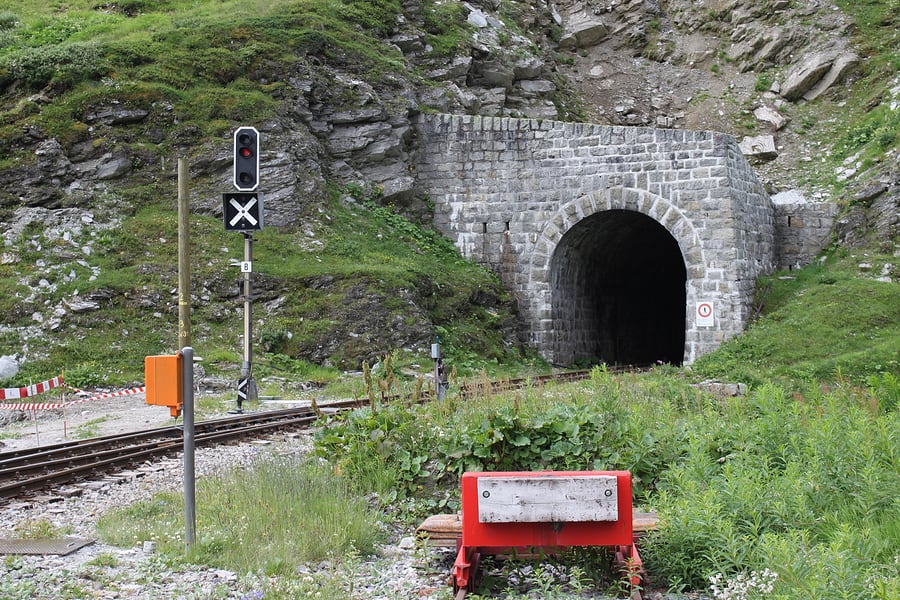
Beyond the platform the line enters the Furka summit tunnel, 1,874 metres long, finished in 1925, and the only substantial stretch of the railway with no rack in it: it falls at 35 ‰ through the mountain and crosses from Uri into the Valais underground. At 2,160 metres it is the highest place any railway pierces the Alps in Switzerland.
Down to the Rhône
Muttbach-Belvédère, at 2,118 metres, is the west portal's stop — no shelter, a brief halt for operating reasons, and a place walkers get on and off, because the marked path between Gletsch and the Furka pass runs past it. From here the Rhône valley opens below, and the rack resumes for the descent.
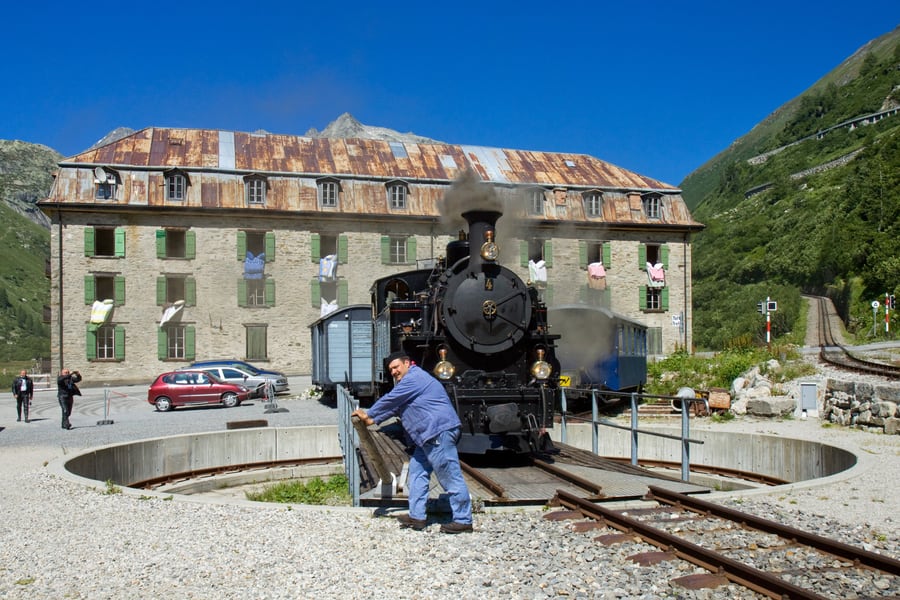
Gletsch, 1,757 metres, is the hamlet on the valley floor where the Rhône leaves its glacier. The station has a waiting room, toilets and step-free access to the trains, and a turntable beside it on which the steam locomotives are turned by hand — the rack engines can only climb chimney-first. The Rhône Glacier is the reason Gletsch exists at all; in the 1850s its tongue came almost to the hotel doors, and the polished bare rock and moraine around the village mark where the ice stood in 1856.
The last stretch down to Oberwald, 1,366 metres, was the final piece of the railway to reopen, on 12 August 2010. The DFB station there stands beside the Matterhorn Gotthard Bahn's, joined to it by an underpass, and the Furka base tunnel's car-shuttle trains load a few metres away.
The locomotives, and where they have been
Seven steam locomotives are on the books. The smallest, HG 2/3 No. 6 Weisshorn, was built for the Visp-Zermatt railway in 1902, ended up as a works shunter, and stood on a plinth outside a school in Chur until the schoolchildren gave it to the DFB in 1988 on the condition that it be made to work again. It steamed in 1990.
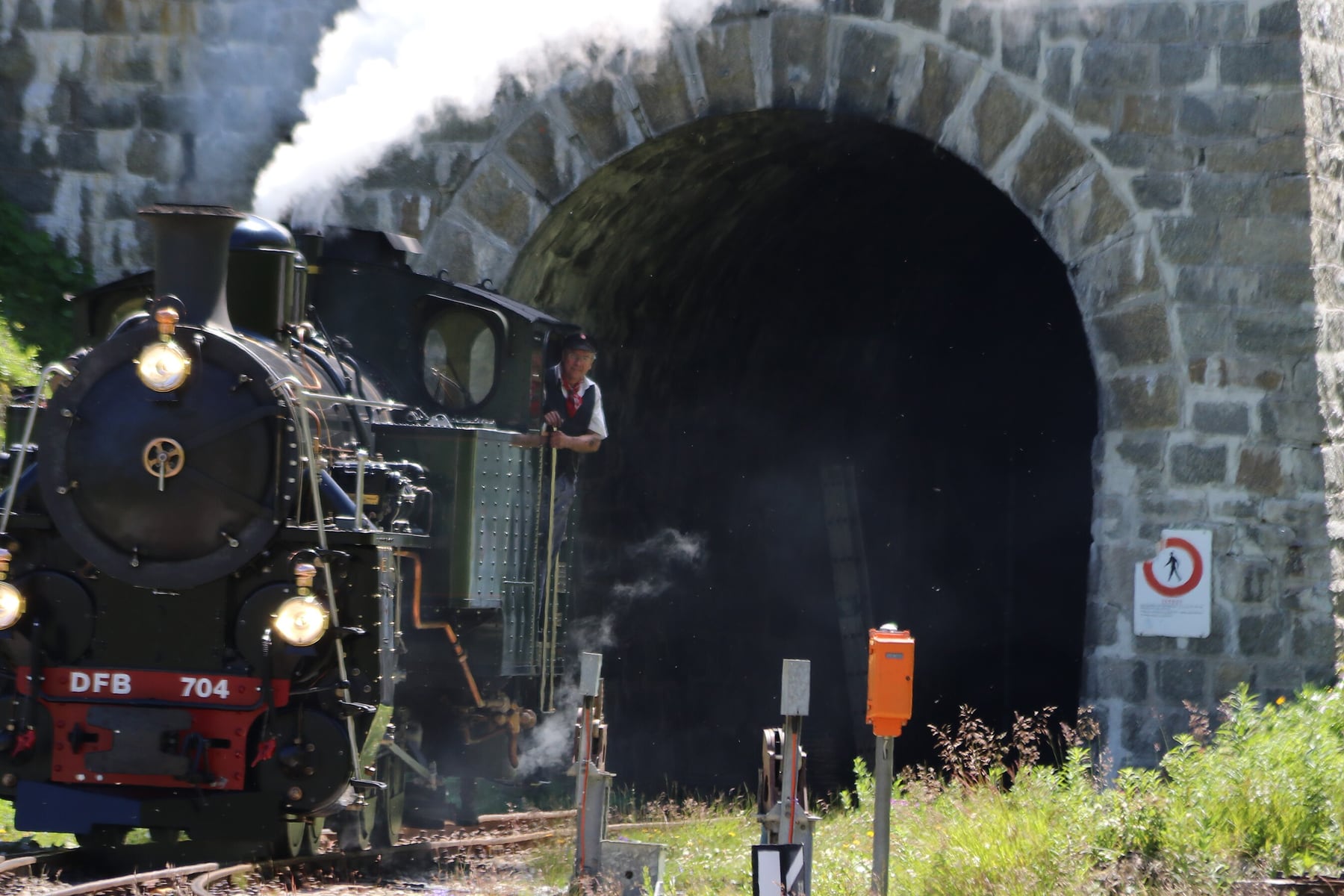
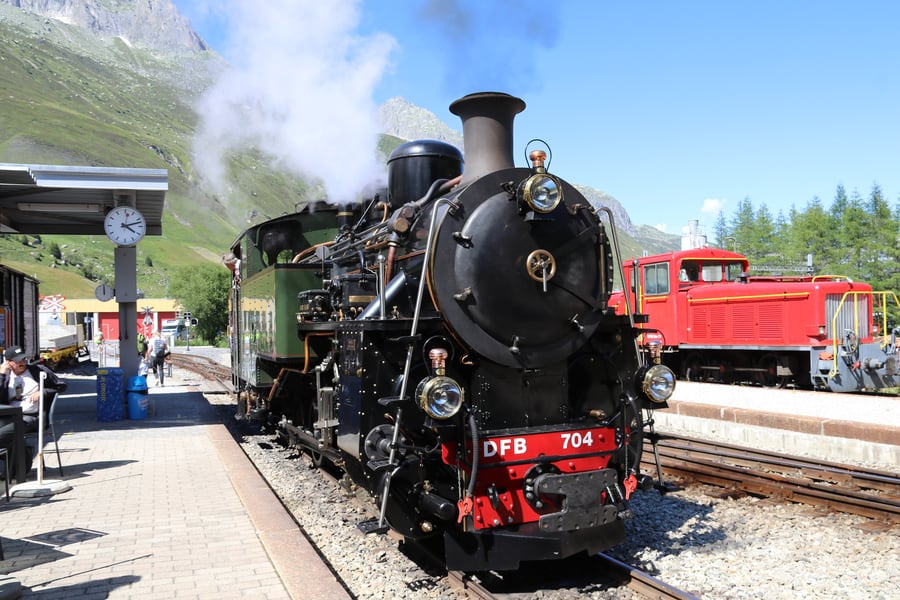
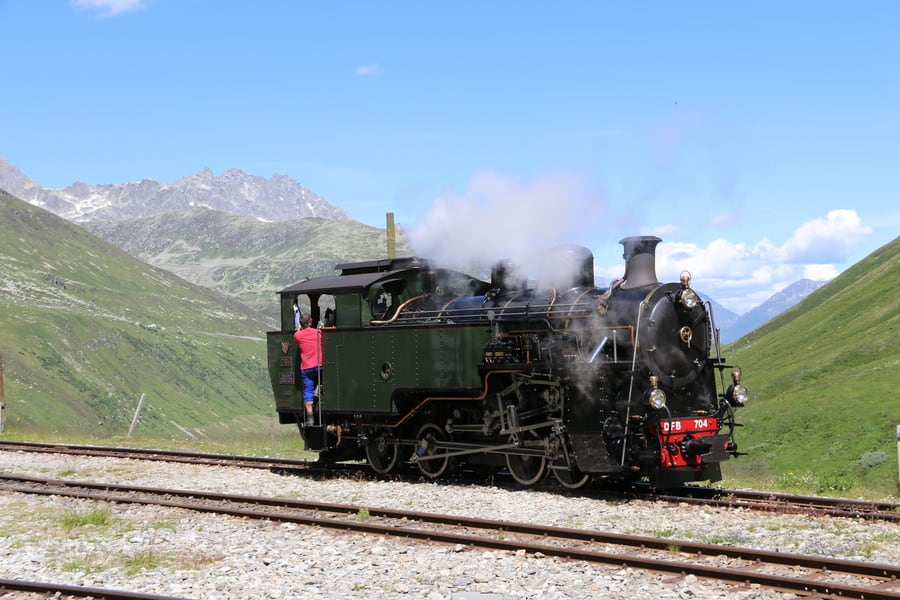
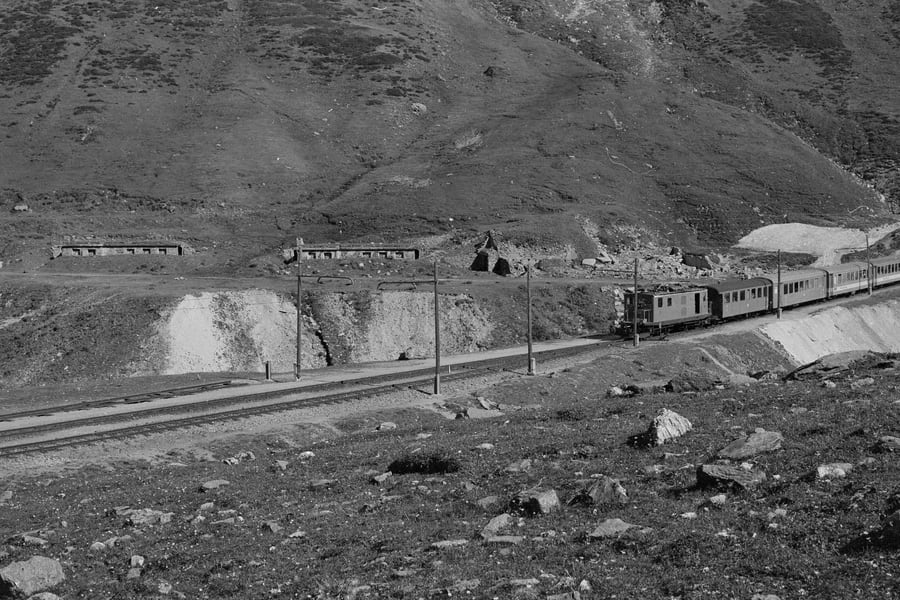
The rest have a longer story. Ten HG 3/4 rack locomotives were built in Winterthur in 1912 and 1913 for the line over the Furka. When the Furka-Oberalp finished electrifying in 1947 it sold four of them to the Chemins de fer français de l'Indochine, and they went to what is now Vietnam to work the forty-three kilometres from Song Pha up to Đà Lạt — a rack line steeper than this one, at 120 parts in a thousand. They ran until 1967, made their last movements in 1975, and were then left beside the track and in a shed to rot. Two heavier HG 4/4s built by SLM in the 1920s, delivered straight to Indochina and never used in Switzerland at all, were nearby.
The idea of fetching them back came up in 1988. Two years of negotiation later, an operation the railway still calls Back to Switzerland brought four HG 3/4 and two HG 4/4 home in 1990. No. 1 Furkahorn was rebuilt at Meiningen and returned to the Furka on 9 June 1993, in cobalt blue; No. 704 was presented at the railway's own works at Uzwil in June 2018 and took its first passengers in June 2019; No. 708 reached Realp in September 2023 and entered service during 2024. No. 1 came back from a full overhaul and ran the mountain line again on 17 July 2025.
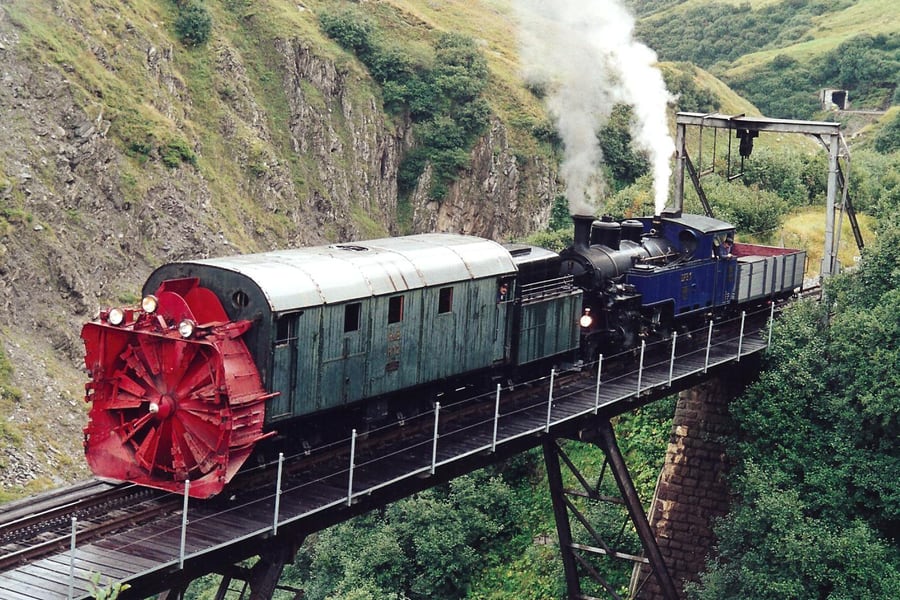
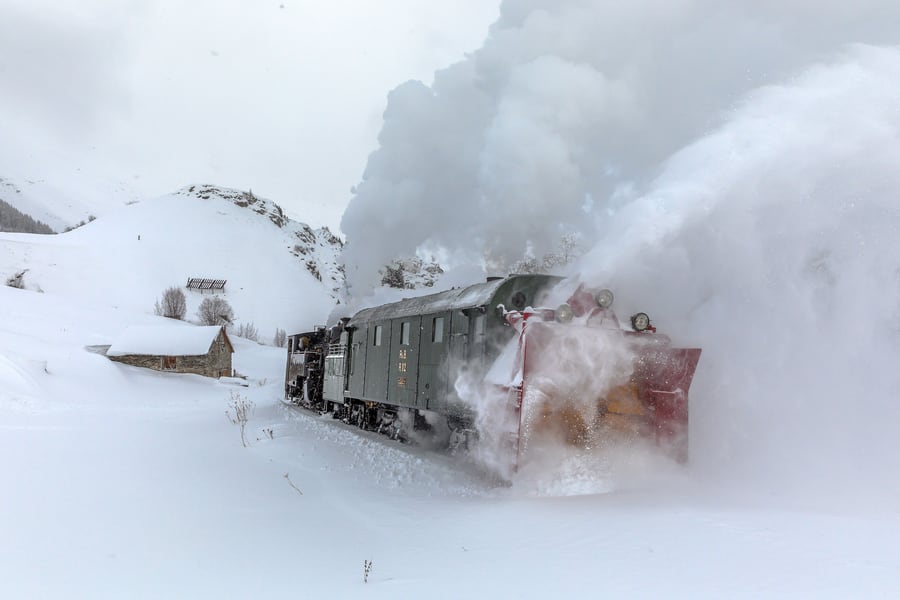
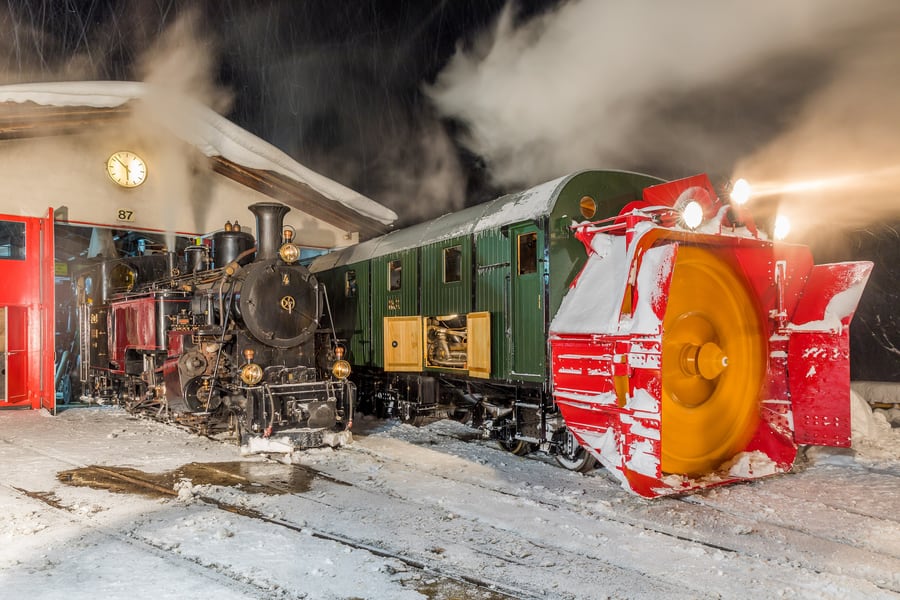
There is also a rotary snowplough. The Xrotd R12 was built for the Rhaetian Railway in 1913, worked there until the late 1950s, went to the Blonay–Chamby museum line in 1971, and came to the DFB in 1996 in exchange for an almost identical machine that could not manage a rack. A group of about ten people led by Martin Horath overhauled it from 2002, and it made its first test run above the Realp depot on 11 December 2020.
What it takes to open
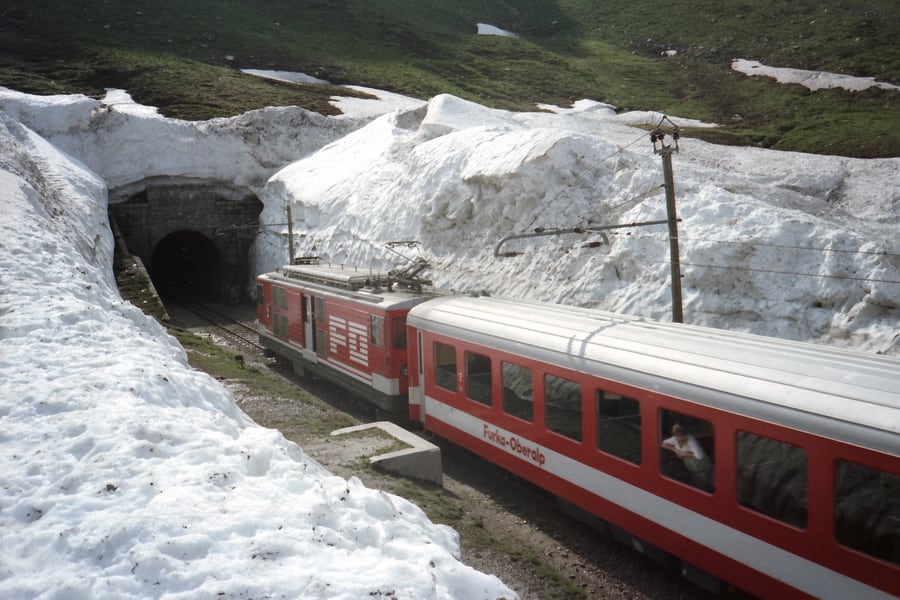
The season is short because the mountain decides it. Between mid-May and mid-June, as many as twenty volunteers work every day for three to four weeks: clearing the snow off the track, erecting the Steffenbach bridge, bringing the buildings out of their winter state, and putting back the points and the safety systems. The railway reckons that on 350 to 450 person-days a year, before a single fare-paying passenger has been carried.
The volunteers are organised through the Verein Furka-Bergstrecke, which has more than 7,500 members in twenty-three sections — twelve in Switzerland, nine in Germany, one in the Netherlands, and one for members with no regional attachment. The Aargau section owns the fourteen historic carriages and runs the carriage works at Aarau; the Eastern Switzerland section looks after the steam locomotives at Uzwil. Around 520 people work for the operating company day to day, and the drivers, firemen, dispatchers, train managers and safety staff all sit the Federal Office of Transport's examinations for their roles.
Along the route
Whgler / Wikimedia Commons · CC BY 4.0 · croppedA bridge that spends the winter lying down
Thirty-six metres in three pieces, thirty-two tonnes of steel on struts hinged at the abutments, laid at the full 110 parts in a thousand of the track it carries. Each autumn the middle span is lowered to hang from the abutment and the outer two fold flat.Markus Giger / Wikimedia Commons · CC BY-SA 4.0 · croppedFour locomotives that went to Vietnam and came back
When the Furka-Oberalp finished electrifying in 1947 it sold four of its 1912 rack locomotives to French Indochina, where they worked the climb to Đà Lạt until 1967. In 1990 an operation the railway calls Back to Switzerland brought four home.Kabelleger / David Gubler / Wikimedia Commons · CC BY-SA 4.0 · croppedWeeks of digging before the first fare
Between mid-May and mid-June as many as twenty volunteers work every day for three to four weeks to clear the snow, erect the Steffenbach bridge and put back the points — 350 to 450 person-days a year before a single passenger travels.A bit of history
Culture & experiences along the way
 Bohdan Urbanowicz / Wikimedia Commons · CC BY-SA 3.0 · cropped
The Rhône Glacier ice grotto
A tunnel cut fresh into the glacier every year, reached by a short paid footpath off the pass road above Gletsch. The ice at the back of it is thousands of years old.Cassinam / Wikimedia Commons · CC BY-SA 3.0 · croppedWalking down from Muttbach
The marked path between the Furka pass and Gletsch runs past the Muttbach-Belvédère stop, and the diesel train calls there — so the mountain can be ridden up and walked down.Markus Giger / Wikimedia Commons · CC BY-SA 4.0 · croppedThe buffet at 2,160 metres
Every steam train stands about twenty-five minutes at Furka station. There is a heated tent with tables, local produce over the counter, and in dry weather the tables come out onto the platform.Timetables
The 2026 season runs from 18 June to 27 September, Thursday to Sunday. Outside those dates there is no service at all: the Steffenbach bridge is down and the line is under snow.
Times below are the Swiss national timetable for route 615, in the edition dated 26 September 2025, and were checked against the operator's booking system in August 2026.
Realp → Oberwald
| 325 | 133 | 139 | 241 | 157 | |
|---|---|---|---|---|---|
| Realp DFB | 09:15 | 10:20 | 11:20 | 14:20 | |
| Tiefenbach DFB | 09:25 | 10:40 | 11:40 | 14:40 | |
| Furka arr | 09:40 | 11:05 | 12:05 | 15:10 | |
| Furka dep | 09:50 | 11:30 | 12:30 | 15:30 | |
| Muttbach-Belvédère | 10:00 | 11:35 | 12:40 | 15:35 | |
| Gletsch arr | 10:15 | 12:05 | 13:05 | 16:05 | |
| Gletsch dep | 10:20 | 12:10 | 13:10 | 13:10 | 16:10 |
| Oberwald | 10:45 | 12:35 | 13:35 | 13:35 | 16:35 |
Oberwald → Realp
| 134 | 238 | 154 | 364 | 158 | 366 | |
|---|---|---|---|---|---|---|
| Oberwald | 10:50 | 11:45 | 13:50 | 14:50 | 14:50 | |
| Gletsch arr | 11:15 | 12:05 | 14:15 | 15:15 | 15:15 | |
| Gletsch dep | 11:20 | 14:20 | 15:20 | 16:15 | ||
| Muttbach-Belvédère | 11:40 | 14:40 | 15:40 | 16:30 | ||
| Furka arr | 11:55 | 14:55 | 15:50 | 16:40 | ||
| Furka dep | 12:20 | 15:30 | 16:20 | 16:45 | ||
| Tiefenbach DFB | 12:40 | 15:45 | 16:40 | 17:00 | ||
| Realp DFB | 13:05 | 16:15 | 17:05 | 17:15 |
Which train is which
- 133 and 154 are the steam trains that run on every operating day of the season. End to end they take 2 h 15 up and 2 h 25 down.
- 157 runs Thursday to Saturday only.
- 134 runs Friday to Sunday only.
- 139 and 158 are the high-summer steam workings, Thursday to Sunday from 16 July to 16 August, second class only.
- 241 and 364 replace part of that pairing in the shoulder weeks — Thursday to Sunday from 18 June to 12 July and 20 August to 27 September.
- 325, 238 and 366 are the Wander-Express, the diesel train, which exists so that walkers can ride one section and walk another. It calls at Tiefenbach and Muttbach-Belvédère as well.
Seat reservation is compulsory on the steam trains and is included in the fare. Bicycles are not carried on them; the diesel takes them free between Realp, Muttbach, Gletsch and Oberwald.
The stop at the top
Every steam train stands at Furka, 2,160 metres, for about twenty-five minutes — long enough for the mountain buffet, which is the point of it. Train 154 stands for thirty-five.
Two things worth knowing before booking
Steam is not guaranteed on the lower section. The published timetable carries a standing note that between Oberwald and Gletsch the trains may run behind a historic diesel locomotive instead of a steam locomotive, for technical reasons or when there is a risk of forest fire. In August 2026 that is exactly what was happening: the operator's own site was carrying the notice "Steam trains Realp–Gletsch run as scheduled! Gletsch–Oberwald is diesel-operated due to wildfire risk."
The centenary falls in this season. From 3 to 5 July 2026 the railway marks 100 years of the Furka-Oberalp Bahn, with special workings between Disentis, Andermatt, Realp and Gletsch, an exhibition, and free shuttle trains between Andermatt and Realp on the Saturday and Sunday.
Bookings open 180 days ahead at dfb.ch (opens in a new tab); groups of ten or more go through reisedienst@dfb.ch.
Tickets
A ticket over the Furka is two things added together. Realp to Oberwald in second class on a steam train is CHF 96.00, which splits at the checkout into a CHF 50.00 transport ticket and a CHF 46.00 historic supplement. A Half-Fare Card, GA Travelcard or Swiss Travel Pass halves the transport ticket and leaves the supplement alone, which is why the price with a card is CHF 71.00 rather than half of 96. Interrail, Eurail and FIP buy nothing here at all.
Seat reservation is compulsory on steam trains and is already inside the fare. Booking opens 180 days ahead and trains do sell out in high summer; Realp can sell whatever is left, but only for the same day, and at Oberwald steam tickets come from the platform rather than the MGB counter. Dogs travel on everything except Premium Class. Read at the operator's checkout in August 2026.
Book your tickets
Realp – Oberwald, steam train
CHF 96.00 · CHF 71.00 with a Half-Fare Card, GA or Swiss Travel Pass
A CHF 50.00 transport ticket plus a CHF 46.00 historic supplement, reservation included.
Book Tickets (opens in a new tab, on dfb.ch)via dfb.chRealp – Oberwald, diesel train
From CHF 50.00 · from CHF 25.00 with a Half-Fare Card or GA
The Wander-Express — unreserved, more stops, and bicycles carried free.
Book Tickets (opens in a new tab, on dfb.ch)via dfb.chPremium Class
CHF 300.00 · CHF 250.00 with a Half-Fare Card or Swiss Travel Pass
A reserved compartment, an attendant, an aperitif and a room of your own at Furka.
Book Tickets (opens in a new tab, on dfb.ch)via dfb.chRail Passes
This is one of the clearest cases on the Swiss network, and the answer is unusually blunt.
Interrail and Eurail do nothing here
The operator lists the cards it accepts, and against Interrail, Eurail and FIP it prints no discount. Not a reduction, not a supplement-only arrangement — nothing. A pass holder pays the full CHF 96.00 for Realp to Oberwald in second class, the same as someone with no card at all.
That is consistent with the rest of the batch: the Gornergrat, the Brienz Rothorn and Montreux–Rochers-de-Naye all treat the European passes the same way. Swiss mountain railways outside the national fare network generally do.
Where a pass does help is getting here. The validity map the pass links to lists the Matterhorn Gotthard Bahn's Disentis–Brig–Visp–Zermatt and Andermatt–Göschenen as free rides, which covers Realp and Oberwald, and the whole SBB network on the approach to Göschenen or Brig. So the journey to the foot of the mountain is paid for; the mountain is not.
That map is worth opening rather than trusting the summary table, and it settles this case twice over: the Dampfbahn Furka-Bergstrecke appears neither in the Free ride in Switzerland list nor in the Bonuses for pass holders list, where the Rigi and Pilatus railways get 50% and the Schilthorn 25%.
The Swiss cards all do the same thing
A Half-Fare Card, a GA Travelcard and a Swiss Travel Pass — including the Flex and Youth versions — each halve the transport half of the fare and leave the CHF 46.00 historic supplement untouched. Realp to Oberwald costs CHF 71.00 instead of CHF 96.00 with any of them. The Andermatt / Sedrun-Disentis guest card does the same.
Three Swiss products that sound as though they should help do not: the day pass for Half-Fare holders, the saver day pass and the children's day pass all attract no discount. The Junior Card, the Children's Co-Travelcard and the Swiss Family Card are better than either — a child travelling on one pays the historic supplement and nothing else.
Is a pass worth buying for this journey?
Not for this journey on its own. A Swiss Travel Pass saves CHF 25.00 here, which is a small fraction of what the pass costs, and the saving is the same as a Half-Fare Card would give for far less money. The case for the Swiss Travel Pass is everything else in the region — the Matterhorn Gotthard Bahn, the Glacier Express route, the boats, the buses over the Grimsel and the Nufenen — with the Furka as one component of a wider trip rather than the reason for the purchase.
For a traveller already holding an Interrail or Eurail pass, the honest advice is to budget the full CHF 96.00 on top of it, or CHF 50.00 for the diesel train, and to treat this as a separate excursion that the pass will not touch.
Checked against the operator's own discount list and its checkout in August 2026.
Places to Visit
Six stops, and between them one of the shortest walks to a glacier anywhere in the Alps. Realp and Oberwald are villages with beds and a main-line station; Tiefenbach, Furka and Muttbach-Belvédère are a shelter, a tent and a signboard respectively, and exist for walkers and for the view. Gletsch is a hamlet of a dozen buildings that a hotel and a glacier built.
The walking is the point of the diesel train. The marked path between Gletsch and the Furka pass runs past Muttbach-Belvédère, and the Wander-Express calls at the intermediate stops the steam trains skip, so a day can be a ride up and a walk down.
One caution for 2026: the Hotel Glacier du Rhône at Gletsch, the museum in the Blue House and the historic small power stations are all closed while the hotel is rebuilt. A food truck in the hotel garden and the Infopoint, open daily through the season, are what is there instead.
 Arthur Meyer / Wikimedia Commons · CC BY-SA 3.0 · cropped
Realp
A village of about a hundred and fifty people where the Furka pass road begins to climb, seven minutes by train from Andermatt. A Capuchin hospice stood on the site of the present Hotel Post and is first recorded in 1448; the Capuchins extended it into an inn in 1735, and Goethe stayed in 1779. The DFB station is at the western edge of the village, seven minutes' walk from the main-line platforms, with the depot behind it. Daniel Schwen / Wikimedia Commons · CC BY-SA 4.0 · cropped
Gletsch
A dozen buildings on the valley floor, built by a hotel and a glacier. Joseph Anton Zeiter opened an inn with about twelve beds here in the 1830s; the Seiler brothers rebuilt it as the Hotel Glacier du Rhône, advertised as newly built in June 1862, and when the pass road opened in 1866 they took it from forty beds to a hundred and twenty. That hotel, the museum in the Blue House and the historic power stations are all shut while it is restored; a food truck and the Infopoint stay open. Daniel Reust / Wikimedia Commons · CC BY-SA 4.0 · cropped
The Rhône Glacier
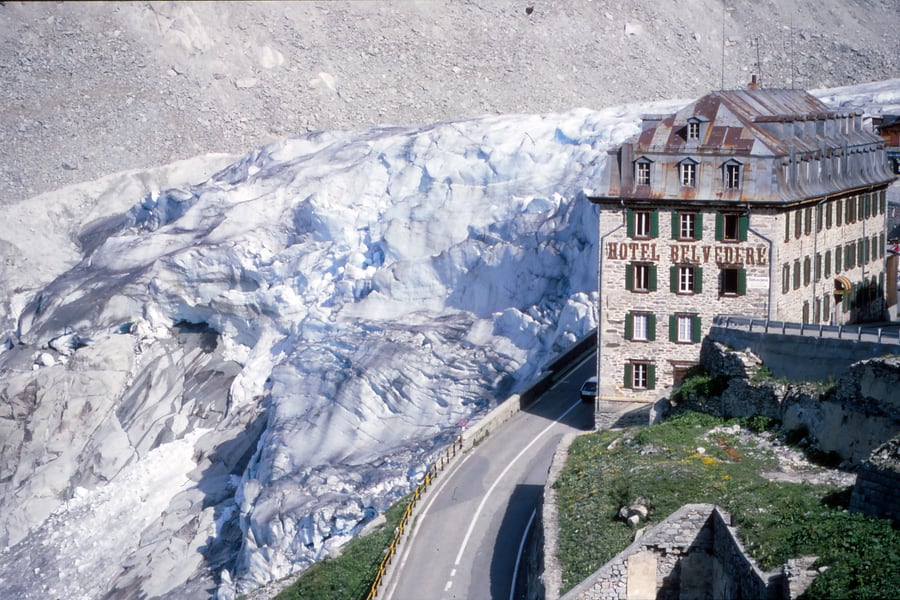
Eight kilometres long, about two wide, some fifteen square kilometres of ice, and the easiest glacier in Switzerland to reach because the pass road runs beside it. Measured since 1874, it has retreated an average of eight and a half metres a year and lost about twenty-five centimetres of thickness annually; the tongue now sits just above 2,200 metres, and a lake began to form below it in 2006. The bare polished rock around Gletsch marks where the ice stood in 1856.Bohdan Urbanowicz / Wikimedia Commons · CC BY-SA 3.0 · croppedThe ice grotto
A tunnel driven into the side of the glacier, recut every year because the ice moves and melts, entered from a footpath a few hundred metres long that leaves the pass road by the old Hotel Belvédère. Inside, the walls are the compressed blue ice of the glacier's interior. There is a charge to walk the path and enter. Whgler / Wikimedia Commons · CC BY-SA 4.0 · cropped
Oberwald
The first village in the Goms, in the upper Rhône valley under the Grimsel, Furka and Nufenen passes. The DFB station stands next to the Matterhorn Gotthard Bahn's and is joined to it by an underpass; the Furka base tunnel's mouth is a kilometre east, and its car-shuttle trains load in the same station. Steam tickets are sold on the platform before departure and not at the main-line counter.Where to Sleep
There is no accommodation on the mountain. Tiefenbach, Furka and Muttbach-Belvédère have no beds of any kind, and the one hotel at Gletsch is shut for rebuilding until at least 2029. That leaves the two ends of the line, and both are small.
Realp is a village of about a hundred and fifty people at the foot of the Furka pass road, seven minutes' walk from the steam railway's own station and a few minutes by train from Andermatt. Oberwald is the first village in the Goms, at the mouth of the Furka base tunnel, with the Matterhorn Gotthard Bahn calling hourly and the car shuttle running through the mountain.
Either end works as a base, and the timetable allows a night at one and a return the next day. Beds are limited in both, and the season is short.
Where to stay
 Arthur Meyer / Wikimedia Commons · CC BY-SA 3.0 · cropped
Hotel Post Realp
In the village centre, by the church
A four-storey timber building in the Jugendstil, put up in 1910 to designs by Georges Meyer with a mansard roof and a small turret, on the site of a Capuchin hospice first recorded in 1448. The Furka Steam Railway itself has leased the house since 2025 and runs its café, its restaurant and its apartments.
Check Availability (opens in a new tab, on posthotelrealp.ch)via posthotelrealp.chHotel Furka
Oberwald, at the foot of three passes
Run by the same family for six generations, in the village at the mouth of the Furka base tunnel, with a restaurant and a sun terrace. The house counts 1,377 metres above the sea and 285 days of sunshine a year among its own figures.
Check Availability (opens in a new tab, on hotel-furka.ch)via hotel-furka.chHotel Restaurant Rhonequelle
Oberwald, open every day
The house traces itself to a wooden kiosk selling drinks that Martin Zumoberhaus of Oberwald set up in 1954, which a later owner from Naters extended into a restaurant under the name Rhonequelle — the source of the Rhône, a few kilometres up the valley.
Check Availability (opens in a new tab, on rhonequelle-oberwald.ch)via rhonequelle-oberwald.ch
Comments
Facebook comments
Facebook will see your IP address and can set cookies. If you are signed in to Facebook it can connect this visit to your account.
Loads Facebook (Meta) content from now on, across the site. Undo this at any time.