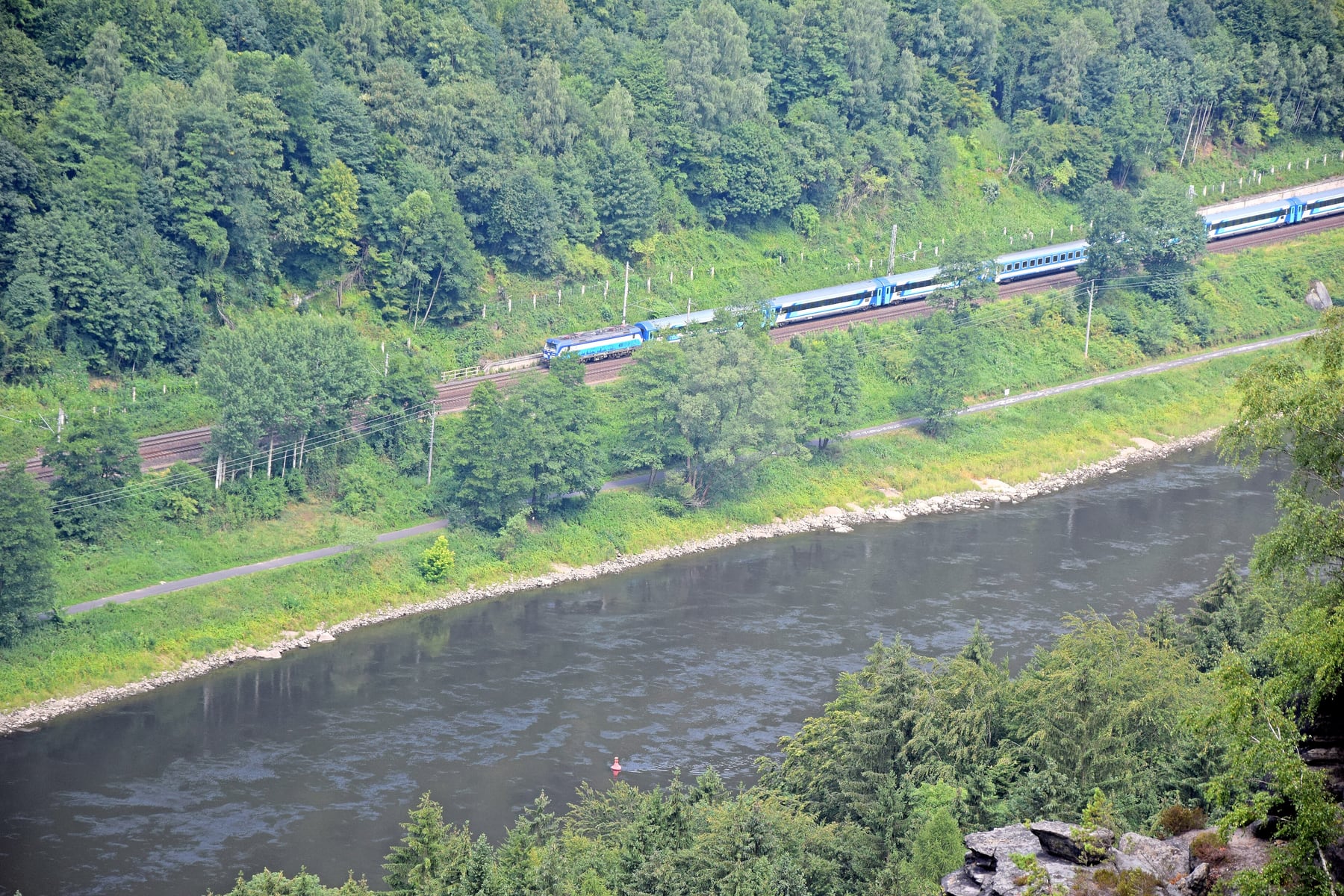
The Elbe Canyon Railway
Jan Kameníček / Wikimedia Commons · CC BY-SA 4.0
- DistanceDěčín–Dresden · 66 km
- Duration48 min by railjet · 1 h 17 by the U28 and the S1
- Best seasonDaily all year · the ferries run every day, from before 05:00 until midnight
Introduction
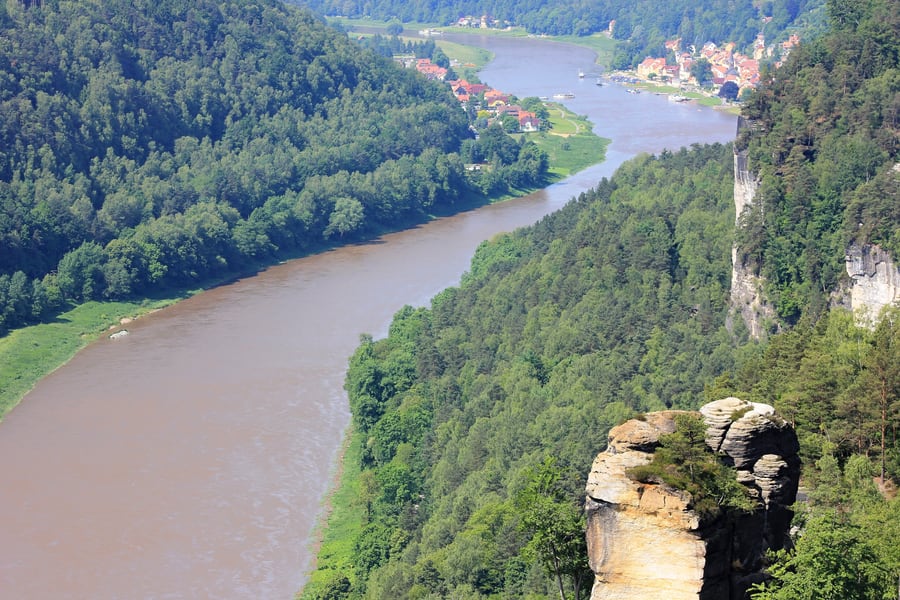
Between Děčín and Pirna the Elbe has cut a gorge through the Elbe Sandstone Mountains, and there was only ever room for a railway on one side of it. The line takes the left bank the whole way and keeps within a few metres of the water, which is why it climbs almost nothing: Děčín station stands at 135 metres above sea level and Stadt Wehlen, thirty-six kilometres downstream, at 125.
The consequence shows up at every stop. Almost everything worth reaching in the gorge — the villages, the rock stage, the spa town, the path to the great sandstone arch — grew on the other bank. So the last few hundred metres of the journey are not made by train at all. They are made in a boat, and at Kurort Rathen the boat is pulled across by nothing but the current of the river.
The lowest way through
This is a main line, not a branch. The Elbe valley is the only place where a railway can pass from Bohemia into Saxony without climbing a mountain range, and at the state border the track is about 130 metres above the sea — the lowest-lying railway in the Czech Republic. Austria and Saxony agreed the route by treaty in August 1842 for exactly that reason, and trains have run the whole way from Děčín to Dresden since 6 April 1851.
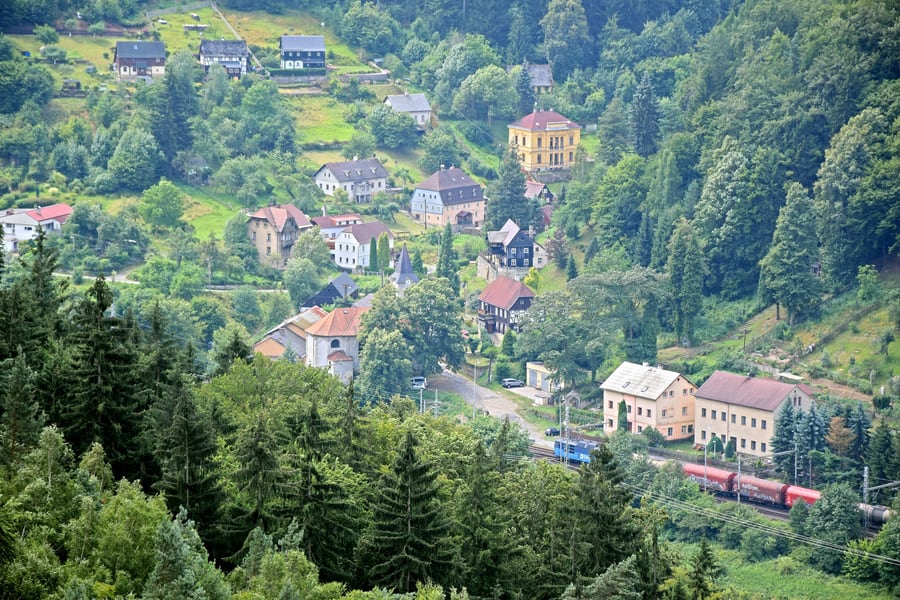
A hundred and seventy-five years later the same forty-five kilometres of riverbank carry a two-hourly railjet between Berlin and Prague, a Dresden S-Bahn every half hour, a cross-border local service that stops everywhere, a sleeper from Brussels, and something like 130 freight trains a day. The scenery is the reason to be aboard; the traffic is the reason the scenery has a railway running through it.
What the journey is
Forty-eight minutes end to end on the fastest train, or an hour and a quarter if the slow way is taken — and the slow way is the point. The all-stations service crosses the border at a gap in the overhead wire where the Czech 3,000-volt direct current stops and the German 15,000-volt alternating current begins, and each locomotive coasts through it with its pantographs down.
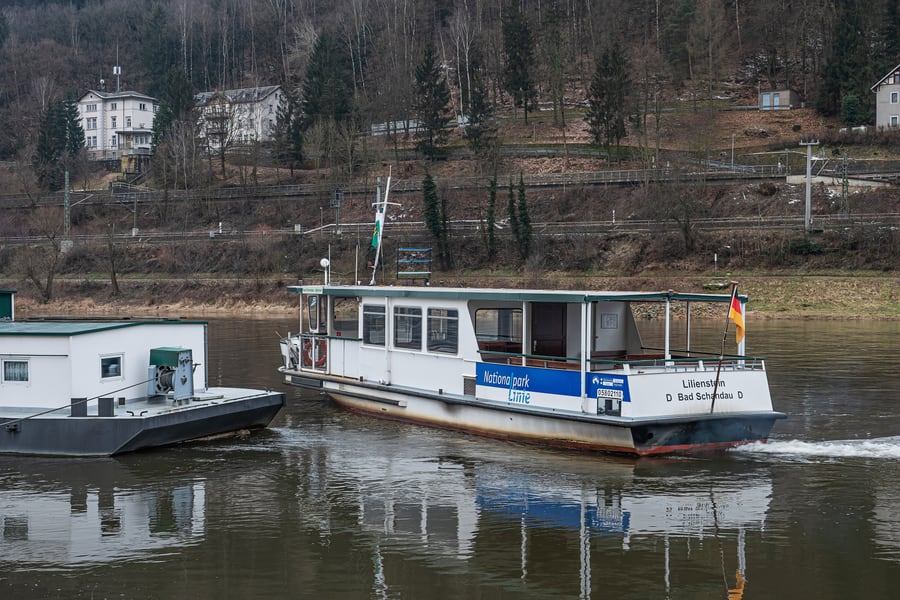
North of that gap the stations arrive in quick succession, and four of them are named after places the train never reaches: Schmilka-Hirschmühle, Bad Schandau, Kurort Rathen and Stadt Wehlen all stand on the bank opposite the village, town or spa they are called after. The ferries that finish those journeys are ordinary public transport, on the regional tariff, running from before five in the morning until midnight, every day of the year.
The Journey
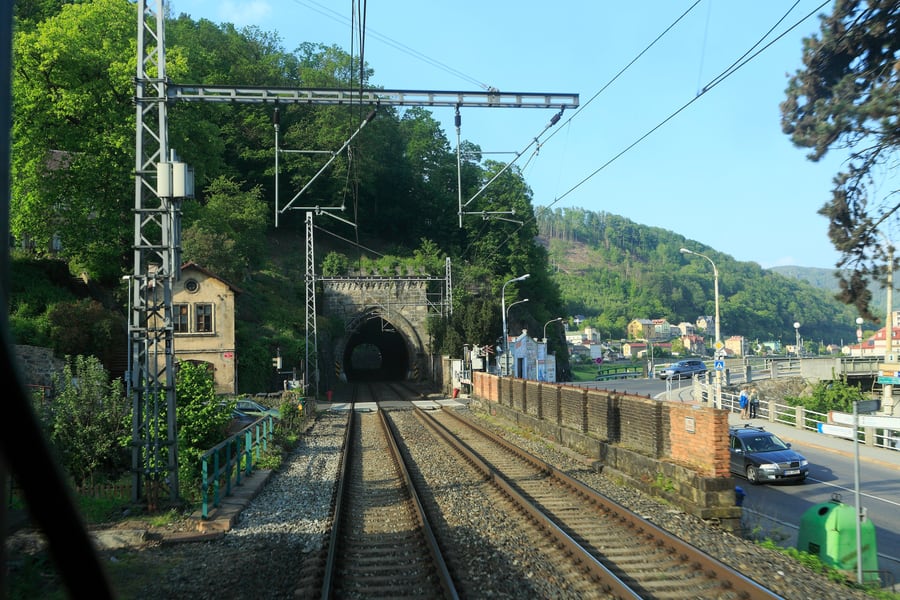
The journey begins at Děčín hlavní nádraží, in the Podmokly district on the left bank, in a reception building that has stood since the line opened in 1851 and is now a protected monument. The train is barely clear of the platform ends before it is inside the first of two short tunnels cut through rock faces that come down to the water: the Ovčí stěna, 279 metres, and the Červená skála, 149 metres. Both are within the station limits. The gorge starts that abruptly.
Down the Czech bank
For the next ten kilometres the railway threads between the rock and the river, through the halts at Děčín-Přípeř and Děčín-Čertova Voda, past the junction at Děčín-Prostřední Žleb where the freight line from Nymburk comes in on the right. Then Dolní Žleb: a single street of houses along the water, a station with a passing loop, and no road out along the valley. From the Belvedér lookout on the cliff above, the whole arrangement is visible at once — the village, the platform, and the ferry that connects them to the far side.
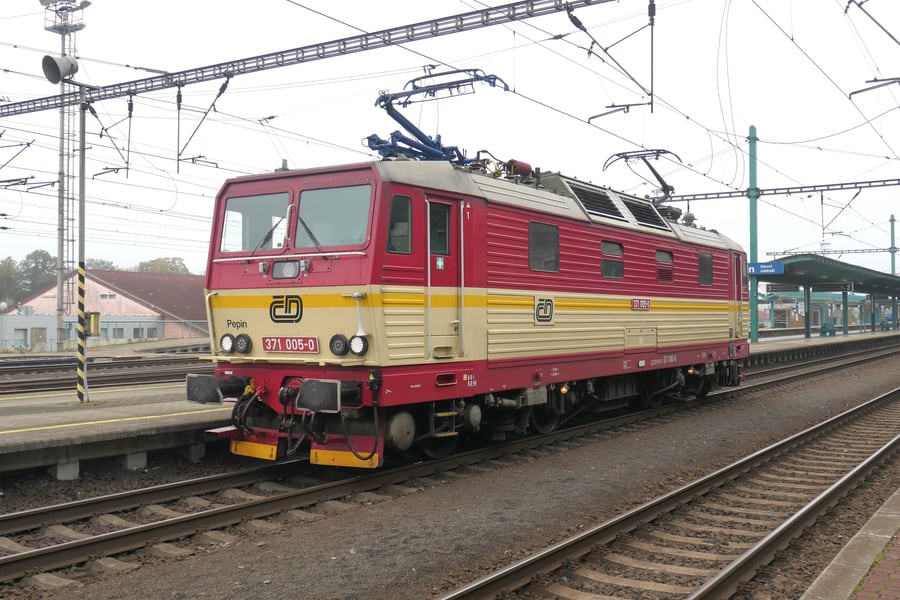
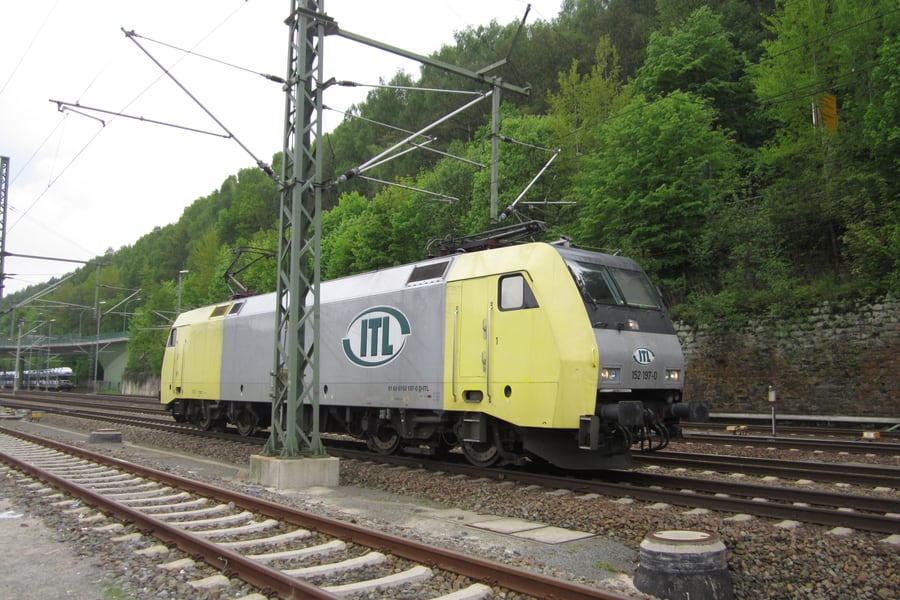
The traction is the consequence of a border between two electrical systems. The Czech network here is wired at 3,000 volts direct current and the German at 15,000 volts, 16.7 hertz alternating current, so anything running through has to work on both. The machine designed for precisely this railway is the one to look for at Děčín: Škoda of Plzeň built it as the Deutsche Reichsbahn's class 230 and the Czechoslovak class 372, a prototype apiece in 1988 and thirty-three more from 1991. It was given a modern body over an already dated electrical system, which is why Czech railwaymen call the type the Bastard. Six were later rebuilt by ČD for 160 km/h and renumbered class 371, in red and cream, and one of those is in the gallery below with the name Pepin on its cab side.
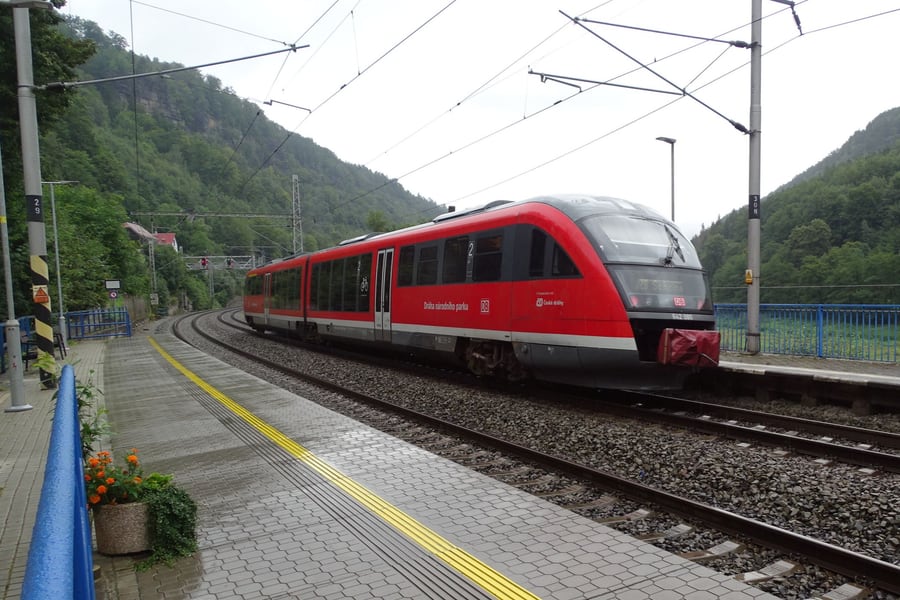
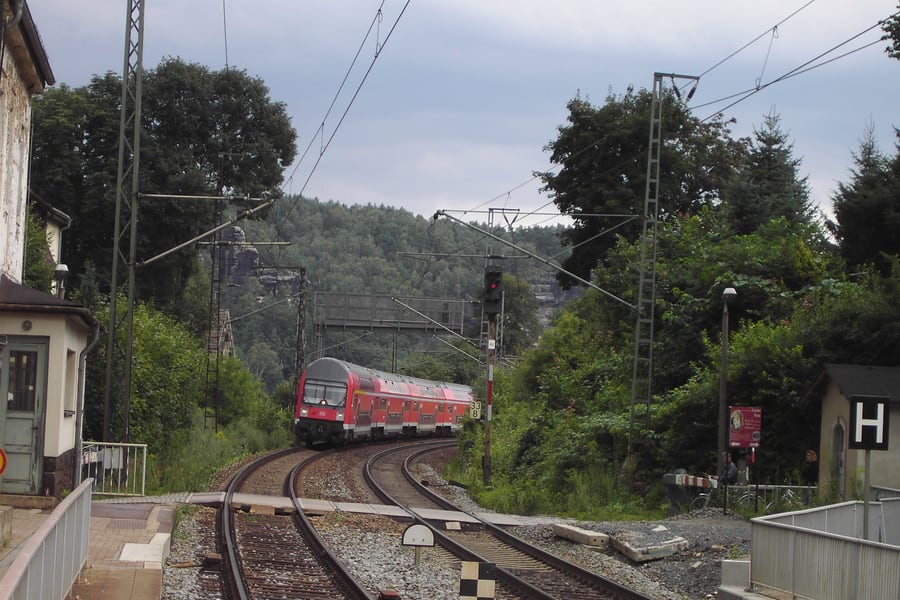
The all-stations train is something plainer: a red DB class 642 railcar, a Siemens Desiro Classic, and the only service of the day that calls at every station on both sides of the frontier.
The gap in the wire
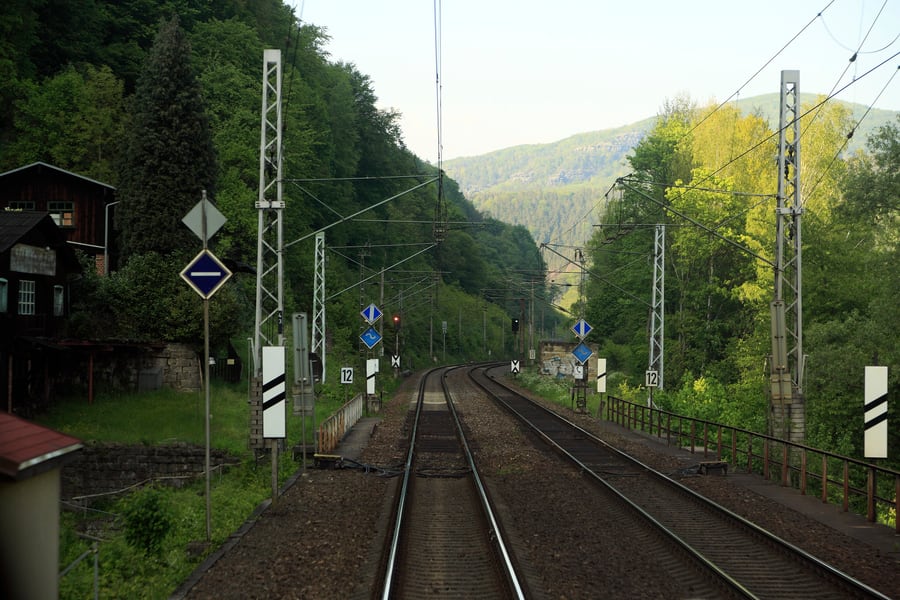
At kilometre 11.859 the line crosses the Gelobtbach on a small bridge, and that bridge is the border. The electrical changeover sits directly on it. Either side of an earthed length of overhead wire there is a dead section, with the direct-current catenary to the south and the alternating to the north, and a locomotive crosses it coasting with its pantographs lowered. There is nothing to see from the window but a pair of signs and a change in the shape of the masts, and it is the quietest border crossing on the route.
Schöna comes two kilometres later. The station is on the German bank; the Czech village of Hřensko, which is the way in to the Bohemian Switzerland national park and to the Pravčická brána, is directly opposite, and the ferry between them is on the regional ticket. Then Schmilka-Hirschmühle, opened on 1 July 1905 to serve a village it cannot reach — the connection to Schmilka is by boat — and immediately afterwards the Hirschmühle viaduct, 83 metres long, whose parapet carries a mark recording the flood of 31 March 1845. The builders set the rail level three Austrian feet above it.
Bad Schandau, and the wrong side of the river
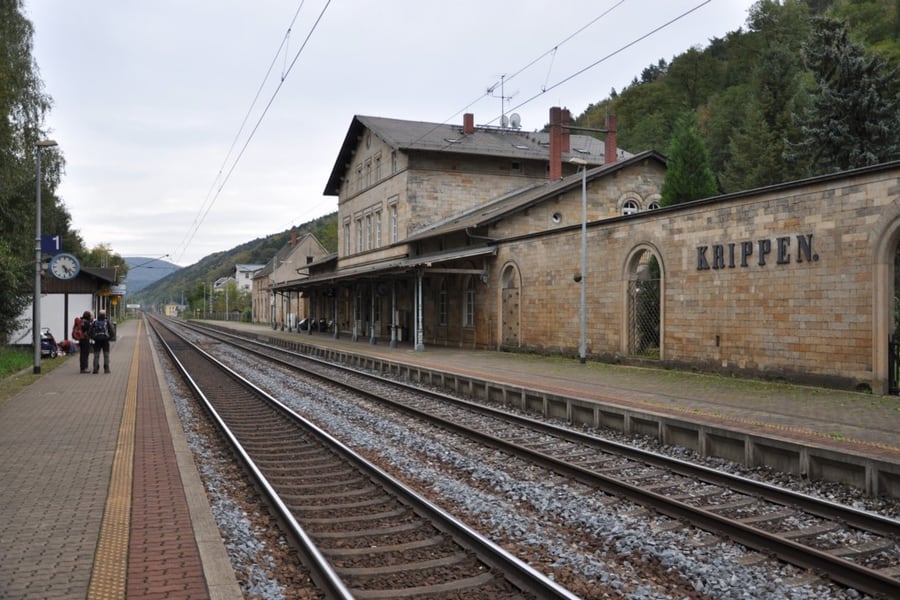
Krippen is the older of the two stations here, and it was the station for Schandau until 1877, when a new one opened where the line from Bautzen came in. The railway wanted to close the original; local objections kept it, and it survives as a halt with a sandstone reception building that has KRIPPEN carved across it. Bad Schandau station, 1.5 kilometres further on, is on the left bank as well — the spa town itself is across the water, reached by the ferry from the station forecourt, or by the B 172 road bridge of 1977, which was closed outright in November 2024 after an inspection and has been under weight restriction since.
Königstein, five kilometres on, is the one significant stop on the same side as its own town, and the exception that makes the pattern obvious: the fortress is straight up from the platform, on a 9.5-hectare plateau standing 240 metres above the river. Just past the halt the line lifts onto the Königstein viaduct, 470 metres of it, the longest structure on the route outside Dresden.
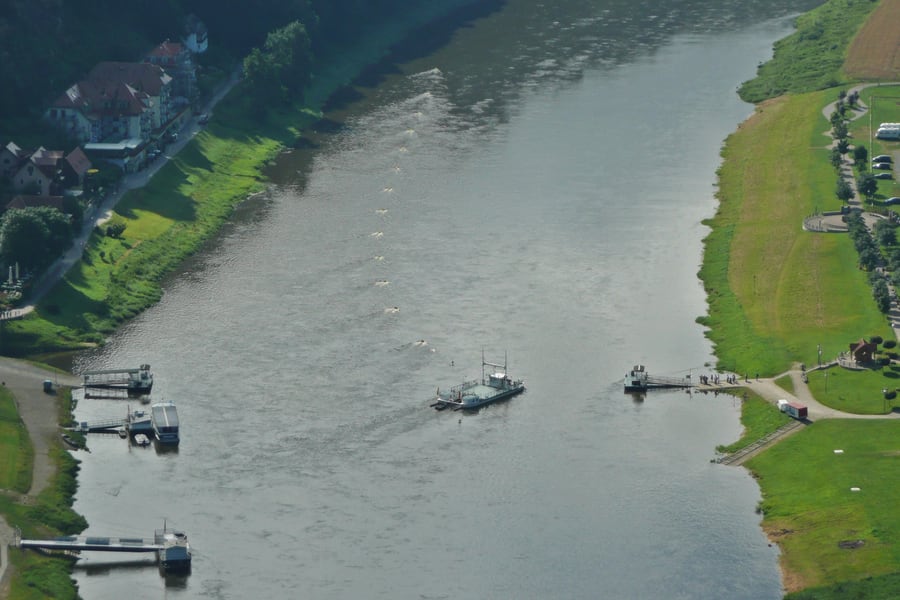
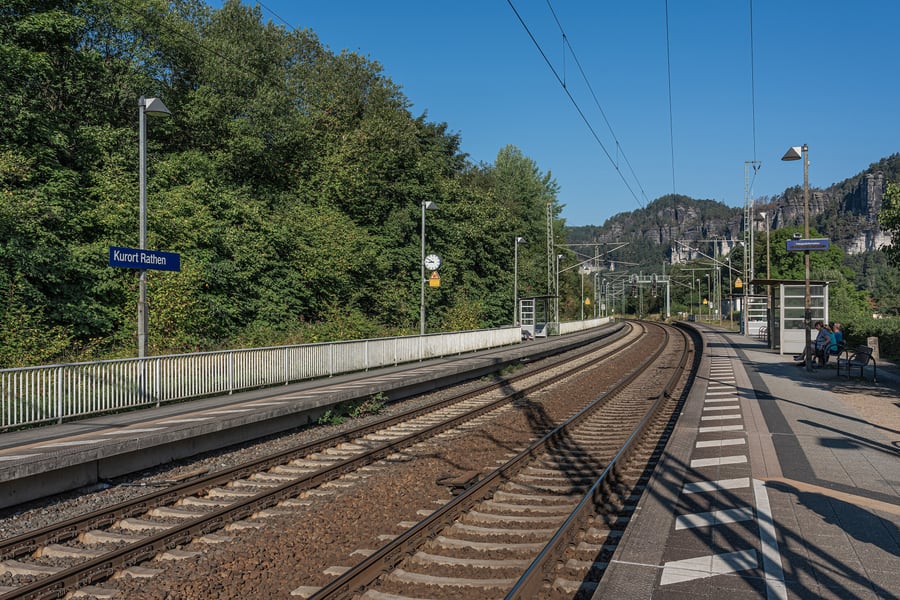
Then Kurort Rathen, where the village, the Amselsee, the Felsenbühne rock stage and the path to the Bastei are all on the opposite bank. The crossing is made on the Bergland, an unpowered catamaran of 1954: it is attached to a cable anchored in the riverbed upstream, angled into the flow, and the current swings it across. It carries 322 people and it has no engine at all. A small diesel ferry, the Ratiner, stands in when ice or high water rules the cable out. Stadt Wehlen follows, opened on 9 May 1850 under the name Pötzscha — and opened, as the line's own record puts it, on the bank opposite the town it is now named after.
Out of the gorge
At Obervogelgesang the cliffs step back, and by Pirna — where the line has run since 31 July 1848, three years before the Bohemian end was finished — the valley has opened into farmland. From here to Dresden the railway is straight and fast, four tracks for much of it, the long-distance pair restored only in December 2004 after they were lifted as reparations in 1946. The last act is the Marienbrücke, a five-track prestressed-concrete crossing of the Elbe, which puts the train on the right bank of the river for the first time since Děčín, a few hundred metres short of Dresden-Neustadt.
Along the route
Falk2 / Wikimedia Commons · CC BY-SA 3.0 deThe lowest railway in the country
Where the line crosses the border it is about 130 metres above sea level, the lowest-lying railway in the Czech Republic. That figure explains the route: the Elbe valley is the only way from Bohemia into Saxony that does not climb a mountain range.A.Savin, Wikipedia · Free Art LicenseFour stations on the wrong bank
As far as Heidenau the railway runs on the left bank; everything else grew on the right. So Bad Schandau, Kurort Rathen and two more each stand opposite the place they are named after, and the ferries connect the villages with their own stations.Kora27 / Wikimedia Commons · CC BY-SA 3.0A flood mark, and the level of the rails
On the Hirschmühle viaduct a gauge mark records the flood of 31 March 1845, and the builders set the rail three Austrian feet above it. That held for a century and a half. In August 2002 the Elbe passed twelve metres and the line shut until October.A bit of history
Culture & experiences along the way
 Rabbite21 / Wikimedia Commons · CC BY-SA 3.0 · cropped
Walk the road the painters took
Saxon Switzerland was made famous by painters before it was made famous by anything else, and the Malerweg — the Painters' Way — is the eighteenth-century walking route they used, now waymarked over 112 kilometres in eight stages. Caspar David Friedrich came here for the sandstone towers, and several stages start at stations on this line.Norbert Kaiser / Wikimedia Commons · CC BY-SA 3.0A ferry with no engine
The crossing at Rathen is made on the Bergland, an unpowered catamaran built in 1954. It is attached to a floating cable anchored in the riverbed upstream, and to work it the crew angle the hull into the flow so that the current swings it across. It carries 322 people, and the diesel Ratiner takes over only when ice or high water rules the cable out. The station is about 200 metres from the landing stage on the Oberrathen side.Pedalito / Wikimedia Commons · CC0Overhead wires flown in by helicopter
Electrification between Schöna and Dresden ran from 1970 to 1976, and the line was too busy to close for it. Part of the answer was to fly masts and cross-span structures into place with an Interflug helicopter — the first time that had been done anywhere in East Germany. Traffic ran throughout. The Czech side was finished on 30 December 1987, which is when through electric working over the frontier finally became possible.Timetables
Four different services use this railway, and the choice between them changes the journey completely. All times below are from the timetable in force in August 2026, checked against the electronic timetable on 17 August 2026.
The fast way: railjet, every two hours
The Berlin–Prague trains run two-hourly in each direction and take 48 minutes between Děčín and Dresden, calling only at Bad Schandau in between. Since the timetable change of 14 December 2025 they carry České dráhy's railjet branding rather than the old EuroCity name.
| Děčín hl.n. | Bad Schandau | Dresden Hbf |
|---|---|---|
| 10:02 | 10:19 | 10:50 |
| 12:02 | 12:19 | 12:50 |
| 14:02 | 14:19 | 14:50 |
Southbound they leave Dresden Hbf at 09:10, 11:10, 13:10, 15:10, 17:10 and 19:10, reaching Bad Schandau about 25 minutes later and Děčín at :53. Beyond Děčín these trains continue to Prague, and several run through to Vienna, Budapest or Villach.
The slow way: the U28 and the S1
The stopping service is the more interesting ride and takes 1 hour 17 minutes with one change. The cross-border U28, marketed as the National Park Railway, runs every two hours and is the only train that calls at every station on both sides of the border.
| Děčín hl.n. | 10:41, 12:41, 14:41, 16:41 |
| Dolní Žleb | 10:54 |
| Schöna | 10:58 |
| Schmilka-Hirschmühle | 11:00 |
| Krippen | 11:06 |
| Bad Schandau (arr) | 11:09 |
At Bad Schandau the S1 of the Dresden S-Bahn connects five minutes later, at 11:14, and runs all stations to Dresden Hbf for 11:58 — Königstein 11:18, Kurort Rathen 11:24, Stadt Wehlen 11:27, Obervogelgesang 11:31, Pirna 11:36.
The S1 is the workhorse of the gorge: half-hourly between Bad Schandau and Dresden, at :14 and :44 past the hour, and hourly on the upstream leg to Schöna. In the other direction it leaves Dresden Hbf at :29 and :59, and the :59 departure is the one that connects into the U28 at Bad Schandau for Děčín.
The first and last trains
The U28 leaves Bad Schandau for Děčín at 05:48 and 06:48, then two-hourly at :48 from 08:48 until 20:48, with a final departure at 23:50. Southbound, the earliest arrival in Děčín from Dresden is 07:17, reached by the 05:59 S1 and the 06:48 U28; the last railjet from Dresden to Děčín is the 19:10. The S1 runs later than either, until around midnight.
Sleepers, and a great deal of freight
Two night trains use the gorge as well. The European Sleeper from Brussels and Berlin leaves Dresden Hbf at 08:45 and reaches Děčín at 09:45 on its way to Prague, and an ÖBB Nightjet for Graz and Budapest passes Bad Schandau southbound at 22:36.
The line is also one of the busiest freight corridors between Germany and southeastern Europe: a count in 2015 put 221 trains a day through the gorge, of which 127 were freight. Watching for them is part of standing on any platform here.
Engineering work, autumn 2026
On a number of dates through late September, October and early November 2026 the cross-border section is closed for engineering work. On those days the international trains do not run through: they are diverted to Ústí nad Labem, where a replacement bus takes over for Dresden, and the journey stretches from 48 minutes to about 1 hour 55. The U28 and the S1 kept running on every date sampled, so the gorge itself stays reachable — but the fast train does not. Sampled closure dates include 28 September, 1, 6 and 12 October and 2 November 2026, while 20 September and 25 October were clear, so the pattern is intermittent rather than a single block. The date is worth checking against České dráhy (opens in a new tab) or the VVO (opens in a new tab) before travelling.
Tickets
The gorge sits inside two national fare systems and one cross-border agreement, and the agreement is what makes the journey easy. The Elbe-Labe-Ticket, issued jointly by the Verkehrsverbund Oberelbe and the Ústí region, is a day ticket valid across the whole VVO area and on most buses and trains in the Ústí district, from the time of issue until 04:00 the next day. It covers the U28 for its full length, the S-Bahn and — the detail that matters — the cross-border Elbe ferry between Schöna and Hřensko. From 1 April 2026 it is €28.50 for one adult with up to two children.
Two exclusions are worth knowing: it is not valid on the Kirnitzschtalbahn tram, and the Rathen ferry is outside the tariff altogether — it belongs to the village and is paid at the gangway, at €1.50 an adult. Neither railway has ticket barriers anywhere on this route; tickets are checked on board.
Book your tickets
The Elbe-Labe day ticket
€28.50 for one adult with up to two children
Both countries, the stopping trains and the Schöna ferry, until 04:00 the next day.
Book Tickets (opens in a new tab, on VVO)via VVOElbe-Labe family and group
€40.50 for a family · €59.50 for up to five people
The same ticket in larger sizes; a bicycle or a dog adds €4.80.
Book Tickets (opens in a new tab, on VVO)via VVODěčín to Dresden by railjet
České dráhy · every two hours · 48 minutes
The through Berlin–Prague trains, calling only at Bad Schandau, sold by either operator.
Book Tickets (opens in a new tab, on České dráhy)via České dráhyRail Passes
A pass is not the obvious purchase for this journey, and the reason is that the journey is short and the local ticket is already cheap.
What a pass covers here
Interrail and Eurail passes are valid on the whole route: on the railjet between Děčín and Dresden, on the S1 through the gorge, and on the U28 across the border, because all three are operated by national railways or on their behalf. A pass day spent on this line will therefore work without any supplement in most of the year.
What a pass does not cover is the part of the journey that is not a railway. None of the Elbe ferries is included — not the crossing to Hřensko, not the one to Bad Schandau, and certainly not the Rathen rope ferry, which is run by the village and stands outside the regional tariff as well. Since reaching the Bastei, Schmilka, the spa town or the national park all mean paying at a gangway, a pass leaves a small but unavoidable set of fares behind it.
The one thing to check before a high-summer crossing
As things stand, reservation on the Berlin–Prague trains is optional. Interrail flags mandatory reservations train by train on its German and Czech pages — the Paris, Brussels and Amsterdam ICEs among them — and the railjet through Dresden and Děčín carries no such flag, read on 20 August 2026.
⚠️ It is still worth one look before travelling in July or August, because this is the frontier the exception is written around. České dráhy has more than once imposed compulsory seat reservation on passengers crossing the Czech–German border at Schöna in either direction for the peak weeks, and it announces the season's rule in spring rather than leaving it standing all year. Reservations bought at the same time as the ticket, through any ČD sales channel, are free of charge — so the cost of complying is nothing and the cost of not knowing is a train you cannot board.
For a pass holder that distinction matters more than it does for anyone else: the pass covers the journey, never the reservation, and there is no way to settle it on board.
Whether it is worth buying
For this journey alone, no. Děčín to Dresden is 66 kilometres, and the Elbe-Labe day ticket covers both countries, the stopping trains and the Schöna ferry for less than a pass day is generally worth — while also being the only one of the two that pays for a boat.
A pass earns its place if the gorge is one link in a longer run. It is the natural crossing between Germany and Bohemia by rail, and a pass already bought for Berlin–Dresden–Prague–Vienna will carry the traveller through here at no extra cost. In that case the sensible pattern is to use the pass for the through railjet and buy a separate Elbe-Labe day ticket for whichever day is spent stopping at the small stations and crossing the river.
Pass coverage and reservation rules checked against Interrail's own German and Czech pages and its list of railway companies, and against České dráhy's published notices, on 20 August 2026.
Places to Visit
Five stops, five places, and four of the five need a boat. The exception is Königstein, where the fortress is straight up the hill from the platform — and its being the exception is what makes the rest of the pattern so noticeable.
The order below follows the train from Děčín down the river to Dresden. Every one of them is a walk-up, or a walk-and-ferry, from a station on the line: none needs a car, and the ferries run all year.
 Pudelek / Wikimedia Commons · CC BY-SA 4.0 · cropped
Děčín castle, above the platform
The castle stands on a sandstone rock above the confluence of the Elbe and the Ploučnice, in the town where the journey begins. A thirteenth-century Gothic castle became a Renaissance one under the lords of Bünau, and the Thun-Hohensteins, who held it from 1628 to 1932, rebuilt it in baroque from 1668 — fifteen years' work that left it a fortress as well as a residence. The Long Ride, a walled ramp up the rock, and the bastions in the Rose Garden survive. Muhx / Wikimedia Commons · CC0 · cropped
The Pravčická brána
The largest natural sandstone rock bridge in Europe: a 26.5-metre span, 16 metres high, an arch only 3 metres thick — two rocks propping each other up, with sensors watching them move. It is walked to from Hřensko, the Czech village with no railway of its own, whose station is Schöna across the water. The fire of 24 July 2022 burned over a thousand hectares of the park; the arch and the Sokolí hnízdo chalet below it were undamaged, and the path from Hřensko is open. A.Savin, Wikipedia · Free Art License · cropped
The Kirnitzschtalbahn
From the Kurpark in Bad Schandau a metre-gauge electric tramway runs 7.9 kilometres up the Kirnitzsch valley to the Lichtenhainer Wasserfall, and has done since 1898. The whole line is single track beside the valley road, with seven intermediate stops and two passing loops, worked as line K. Reaching it means crossing the river from the station first — and the Elbe-Labe day ticket is not valid on the tram. Kora27 / Wikimedia Commons · CC BY-SA 4.0 · cropped
The Bastei
A rock reef at 305 metres, falling about 190 metres to the Elbe, crossed by a sandstone bridge built in 1850–51 to replace a wooden one of 1826. The viewing balcony was closed in May 2016 when weathering was found in the rock beneath it and could not be secured; after five years of stabilisation a new 21-metre platform holding 140 people opened on 3 February 2023. The approach is the classic one — off at Kurort Rathen, across on the rope ferry, up on foot. NobbiP / Wikimedia Commons · CC BY-SA 3.0 · cropped
Festung Königstein
One of the largest hilltop fortresses in Europe, on a 9.5-hectare plateau 240 metres above the Elbe, and the one major sight on this line that needs no boat at all. Elector Christian I and his heirs made it the strongest fortress in Saxony between 1589 and 1597; a well 152.5 metres deep was sunk into the rock in the 1560s; it has been a museum since 29 May 1955. The walk up from the station is steep and entirely on the railway's own side of the river.Where to Sleep
The gorge is short enough to be done in an afternoon, which is exactly why staying in it is worth doing: the ferries run until midnight, the S-Bahn runs later still, and the rock country empties of day visitors around six in the evening.
Three places below, one on each side of the border and one that can only be reached by boat. Prices change constantly and none is quoted here; each card links to the property's own site.
Where to stay
Hotel Praha Hřensko
In the Czech border village, opposite Schöna station
A hotel in Hřensko, at the mouth of the Kamenice where the national park begins, open since the autumn of 1996. Its own site lists a restaurant, a wellness area and air-conditioned rooms, and describes the walks from the door — the Pravčická brána and the gorges of the Kamenice are both on foot from here. The village has no railway: the station is Schöna, directly across the Elbe, and the ferry between them is on the regional day ticket.
Check Availability (opens in a new tab, on hotel-hrensko.cz)via hotel-hrensko.czHotel Elbresidenz an der Therme
On the market square in Bad Schandau, across from its own station
A spa hotel on the Markt in Bad Schandau, a few minutes from the Elbe promenade and the landing stage where the ferry from the station arrives. Its operator's site lists a rooftop spa, a pool, sauna and gym, and the Elbterrasse restaurant, and the Toskana Therme is beside it. The railway station is on the far bank — the ferry across is part of the arrival.
Check Availability (opens in a new tab, on toskanaworld.net)via toskanaworld.netZeitgeist Rathen
In Niederrathen, which no road reaches
A hotel directly on the Elbe in Kurort Rathen, on the bank the railway does not serve. Its own site is plain about the arrival: the village is car-free, cars are left at Oberrathen on the station side, and guests cross on the cable ferry. It lists a large indoor pool, air-conditioned rooms and balconies over the river; the Bastei path and the Felsenbühne rock stage start a short walk away.
Check Availability (opens in a new tab, on steiger-hotels.com)via steiger-hotels.com
Comments
Facebook comments
Facebook will see your IP address and can set cookies. If you are signed in to Facebook it can connect this visit to your account.
Loads Facebook (Meta) content from now on, across the site. Undo this at any time.