Bernina Express
Kabelleger / David Gubler / bahnbilder.ch · CC BY-SA 3.0
- Distance61 km (Bernina line)
- DurationAbout 4 hours (Chur–Tirano)
- Best seasonYear-round — green in summer, snow spectacle in winter
Introduction
The Bernina Express does something that ought to be impossible. In a little red train barely wider than a bus, on rails just a metre apart, it climbs to 2,253 metres at the Bernina Pass — the highest railway crossing in the Alps — and does it entirely by grip, without a single toothed rack rail to haul it up. Then it tips over the roof of the continent and spirals all the way down to the palm trees and vineyards of northern Italy.
It is the boldest of Switzerland's great panoramic journeys, and in some ways the most extraordinary. Over roughly four hours it runs from German-speaking Chur, Switzerland's oldest town, to Italian-speaking Tirano in the Valtellina, crossing the entire spine of the Alps in a single sitting — through 196 bridges, 55 tunnels, past glaciers close enough to chill the window, and along a stretch of railway so remarkable that UNESCO made it a World Heritage Site.
Unlike its famous cousin the Glacier Express, the Bernina Express never needs a cog to climb: everything you see it do, it does on ordinary wheels and sheer nerve.
The Journey
The Bernina Express links two very different worlds, and it does so along two connected railways that together form the UNESCO World Heritage site "Rhaetian Railway in the Albula / Bernina Landscapes," inscribed in 2008.
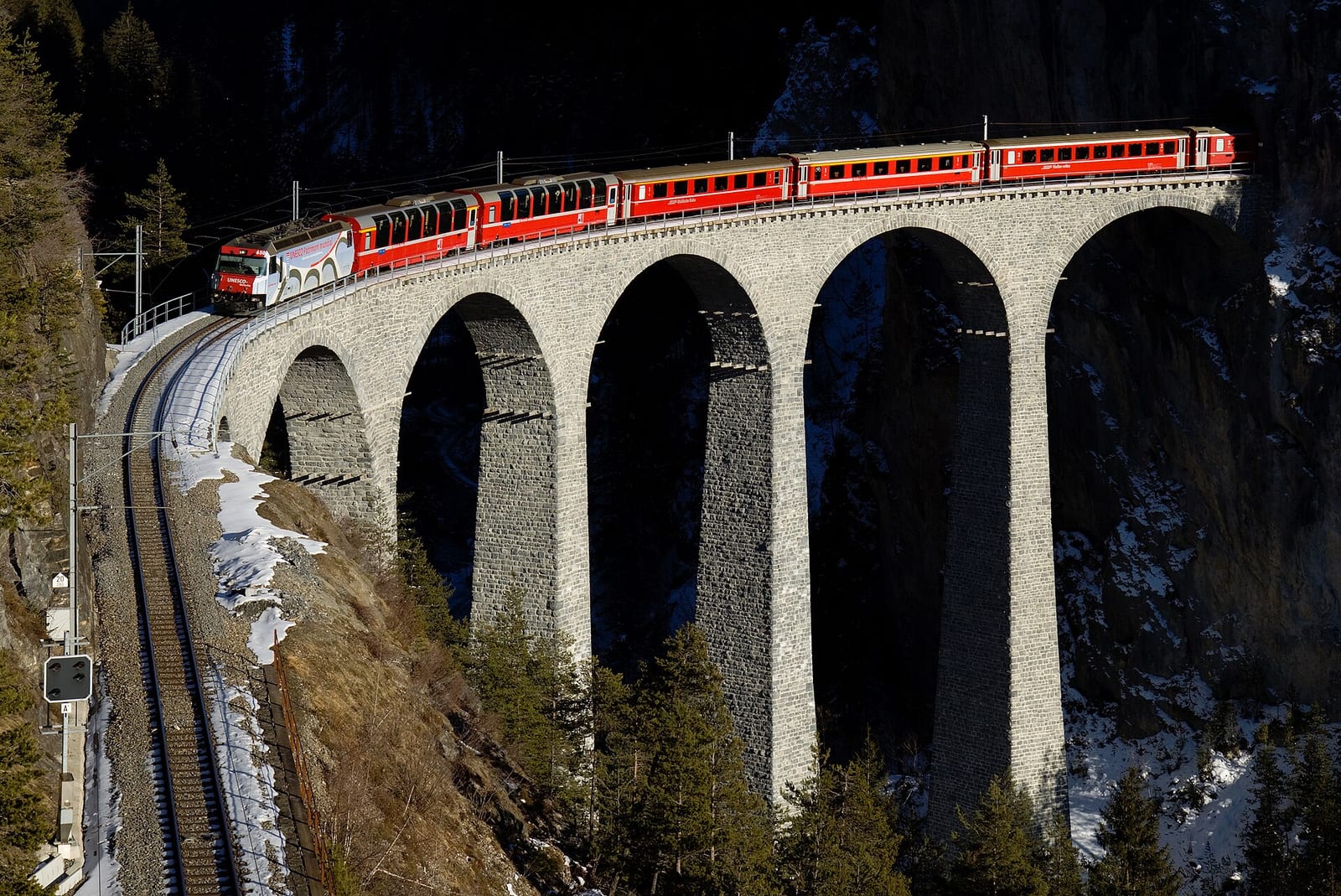
The first is the Albula line (built 1898–1904), which carries the train out of Chur and up into the mountains. This is where you cross the single most photographed structure on any Swiss railway — the Landwasser Viaduct, a curved six-arch bridge that runs straight off a cliff into a tunnel mouth — before the line loops through spiral tunnels and bores under the Albula Pass to reach the high Engadine.
The second, and the star, is the Bernina line itself (opened in stages from 1908, completed in 1910), a feat of nerve as much as engineering:
- It is metre gauge and adhesion-only — no rack, despite gradients of up to 7%, which makes it one of the steepest adhesion railways in the world.
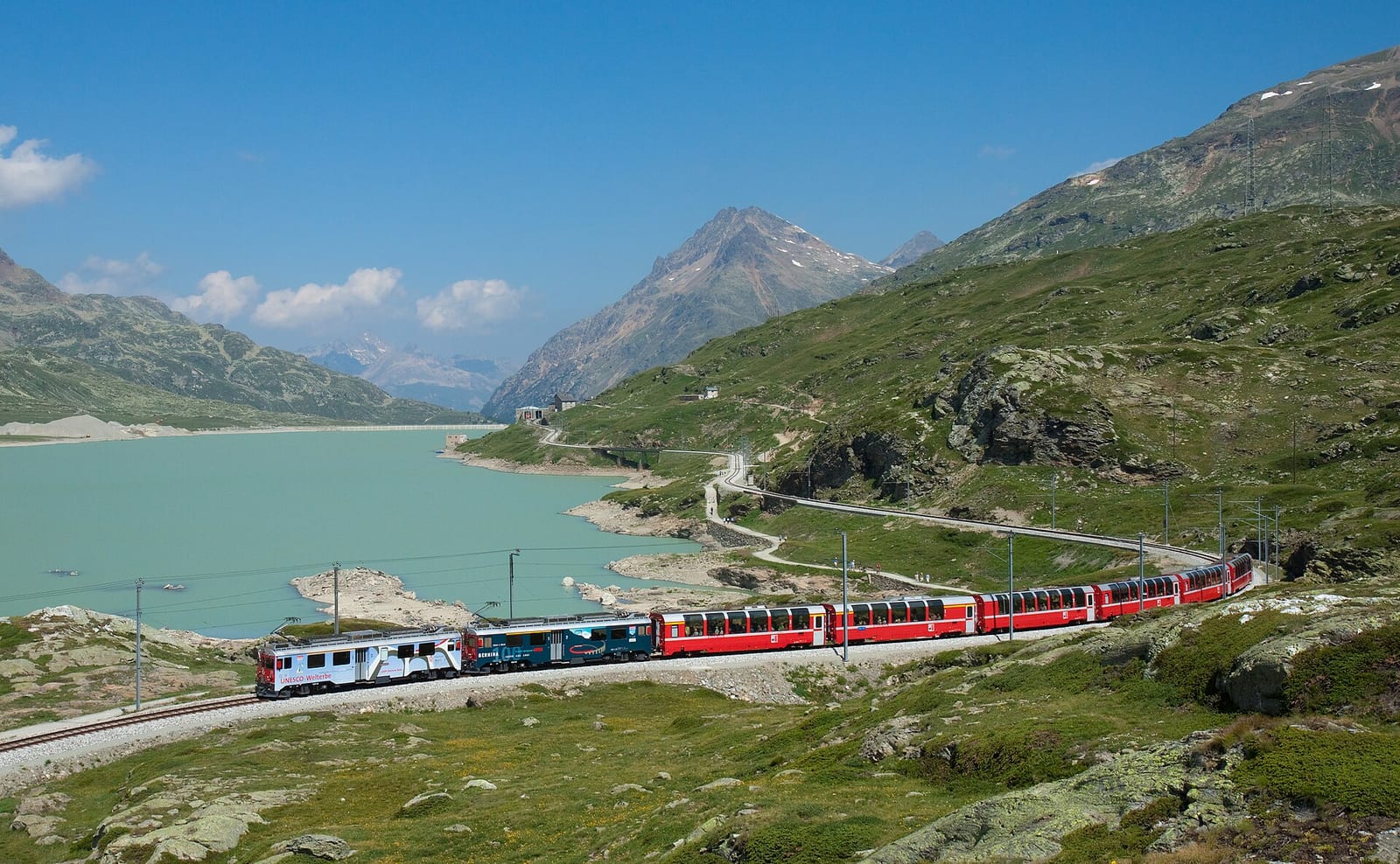
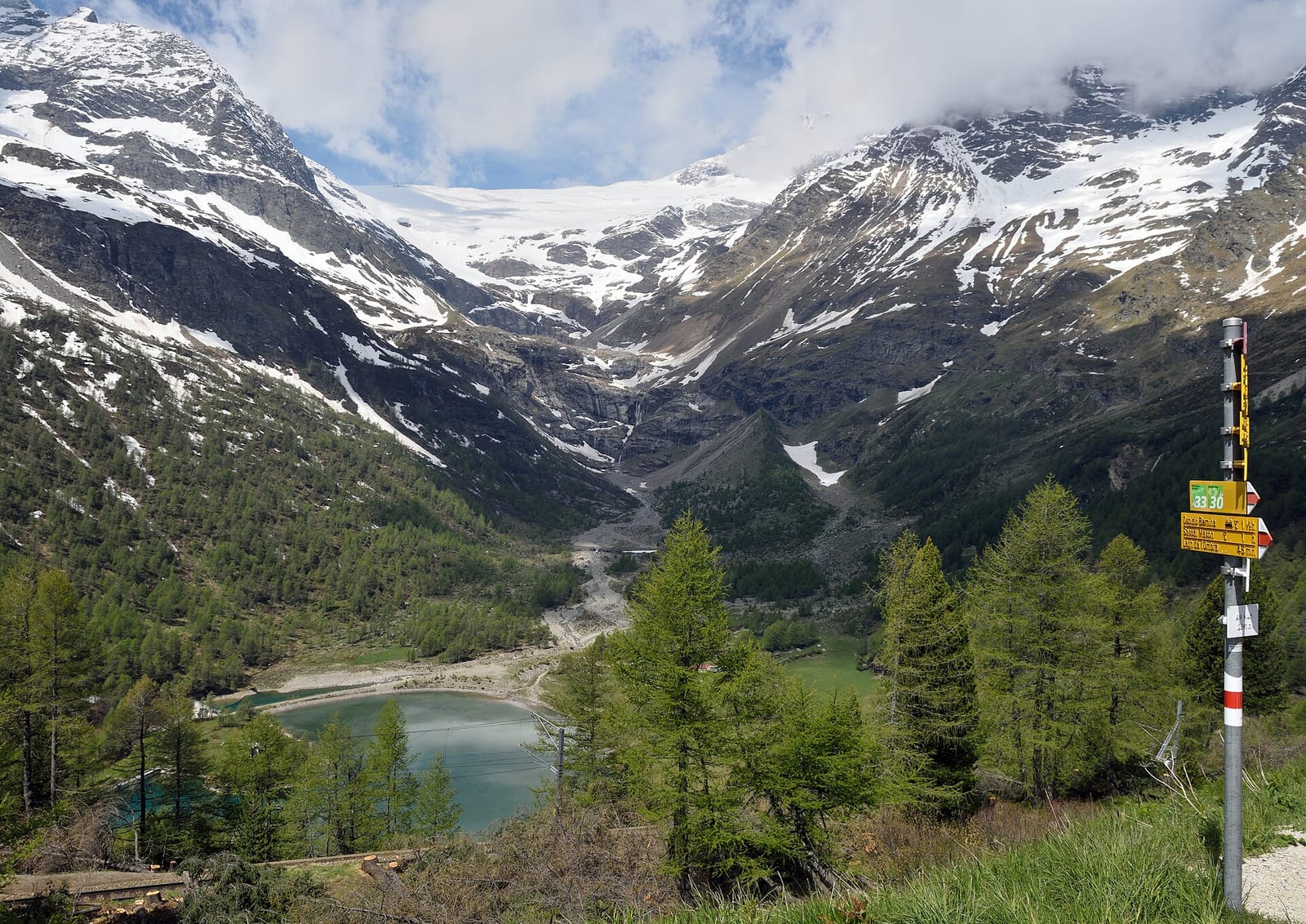
- At Ospizio Bernina (2,253 m) it reaches the highest railway crossing in Europe, running right past the pale, glacier-fed Lago Bianco, whose dam marks the watershed between the Danube and the Po.
- The Montebello Curve frames Piz Bernina — at 4,093 m the highest peak of the Eastern Alps — and the Morteratsch glacier; Alp Grüm looks straight onto the Palü glacier.
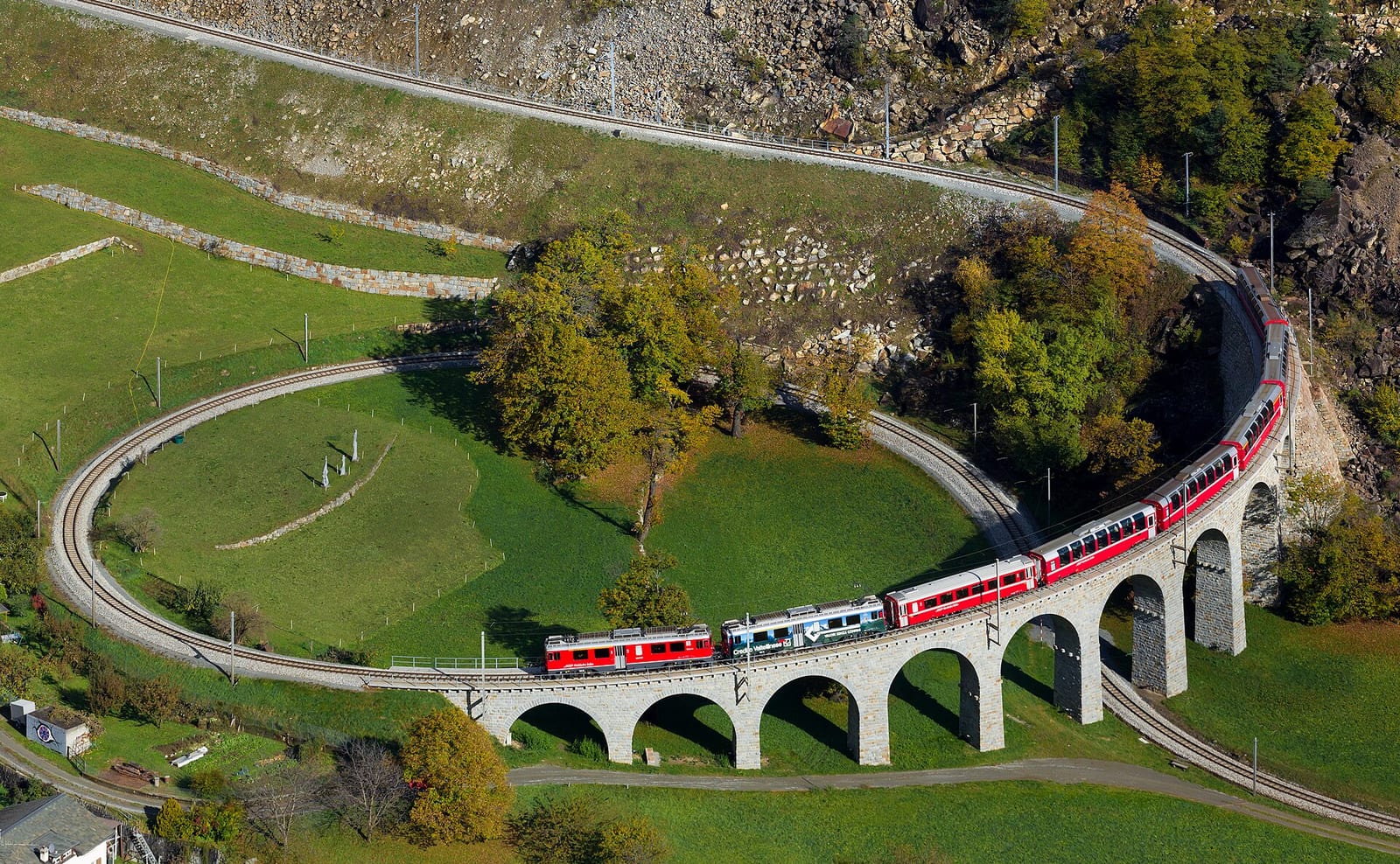
- The Brusio spiral viaduct, near the Italian border, curls the line back over itself in the open air so it can shed height without a rack.
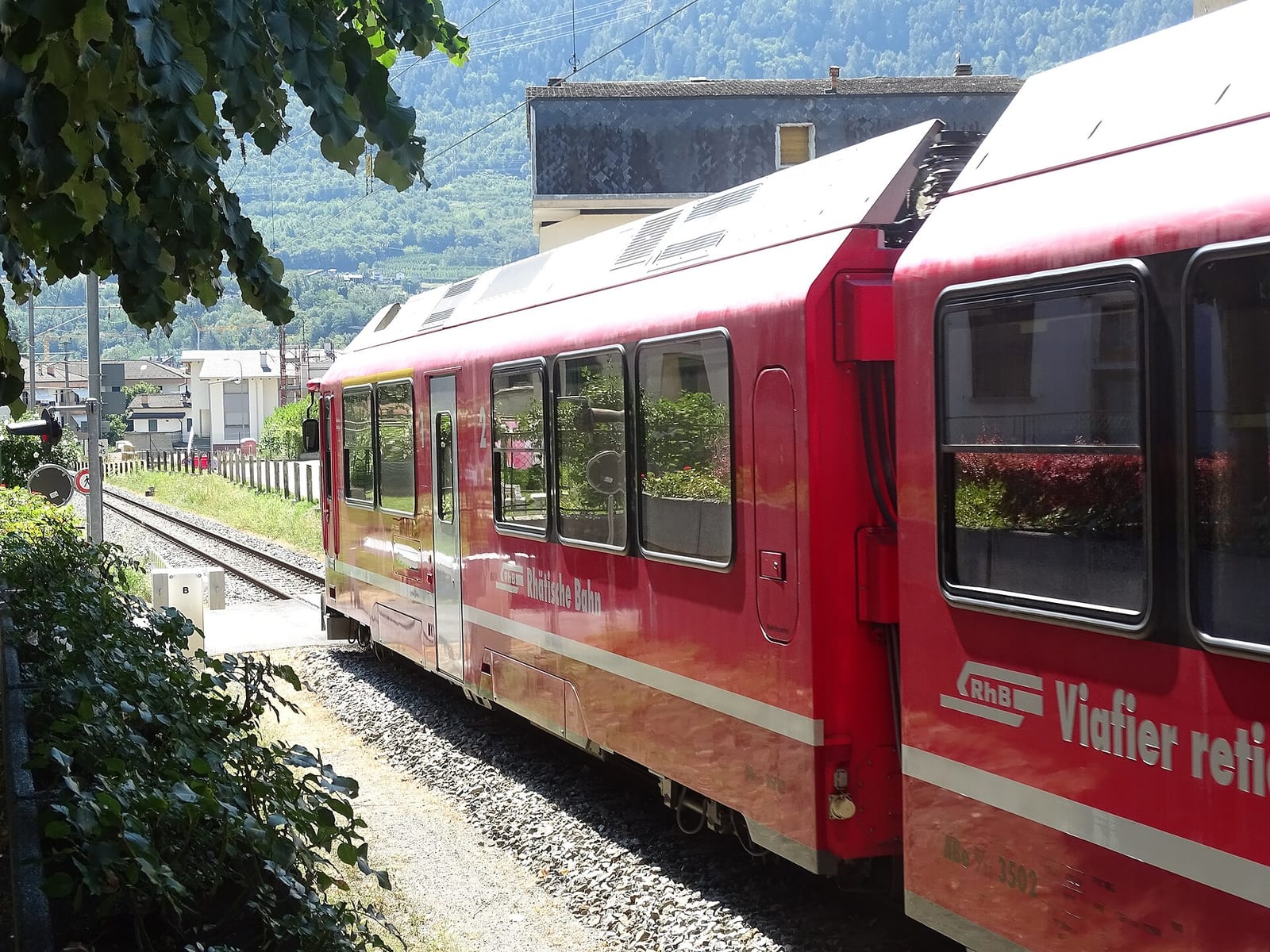
By the time the train rolls through the streets of Tirano to its terminus — you really do share the road with cars for the last stretch — you have descended 1,824 metres from the pass, and crossed from Alpine snowfields to a Lombard piazza. There is no dining car; the whole point is the view.
Along the route
Kabelleger / David Gubler / bahnbilder.ch · CC BY 3.0Brusio spiral viaduct
Below Poschiavo the line runs out of mountainside, so it curls into a stone spiral and crosses over itself — a graceful open-air loop that lets the train shed height without ever needing a rack rail.Kabelleger / David Gubler / bahnbilder.ch · CC BY-SA 3.0Ospizio Bernina & Lago Bianco
At 2,253 metres this is the highest point of the line and the highest Alpine crossing by rail. The pale, glacier-fed Lago Bianco sits right beside the track; its dam marks the watershed between the Danube and the Po.Cayambe / Wikimedia Commons · CC BY-SA 4.0Alp Grüm and Piz Palü
The first station south of the Alps, perched at the tree line with the Palü glacier filling the view. From here the train begins its dramatic hairpin descent into the Poschiavo valley.A bit of history
Culture & experiences along the way
Kabelleger / David Gubler / bahnbilder.ch · CC BY-SA 3.0Panoramic coaches, both classes
The Bernina Express runs in carriages with great curved windows that reach up into the roof, and a multilingual audio guide points out the peaks as you pass. There is no dining car — just a minibar — because here the scenery is the meal.Kabelleger / David Gubler · Public domainA crossing in any season
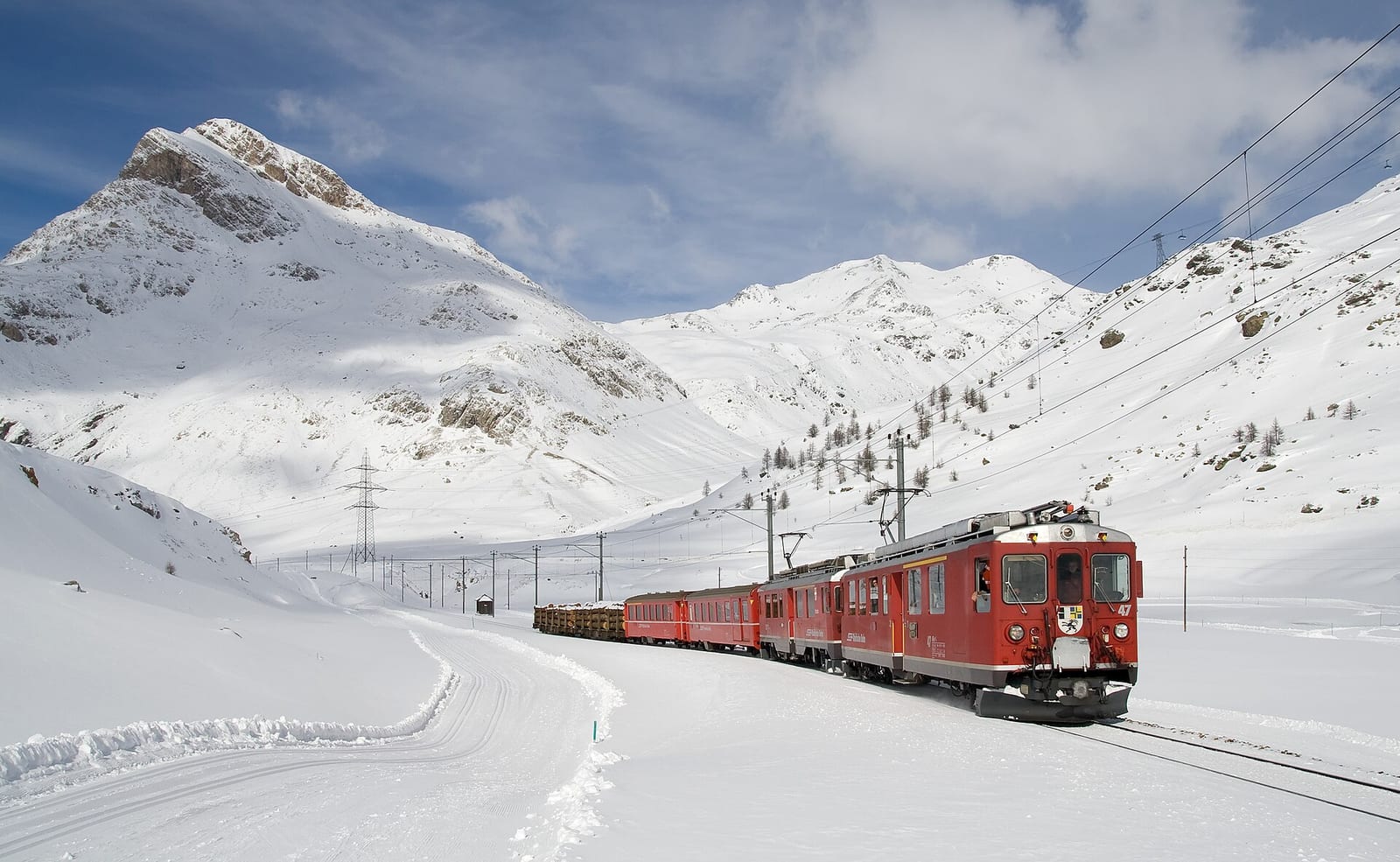
Unusually for an Alpine pass line, the Bernina runs all year. Summer brings green valleys and glacier-blue lakes; winter buries the pass in snow and turns the crossing into something out of a fairy tale.Abxbay / Wikimedia Commons · CC BY-SA 4.0On into Italy — and the Lugano bus
The train ends in Tirano, in the Italian Valtellina, where it trundles through the streets to the station square. Many travellers carry on with the connecting Bernina Express Bus, which skirts Lake Como to Lugano back in Switzerland.Timetables
The Bernina Express is a reserved panoramic train, and it runs less often than you might expect — so it is a train to book, not to turn up for. The classic through service is Chur ⇄ Tirano (about 4¼ hours), with extra runs on the shorter St. Moritz ⇄ Tirano section.
How often it runs (2026 timetable):
| Season | Chur ⇄ Tirano | St. Moritz ⇄ Tirano |
|---|---|---|
| Summer (2 May – 25 Oct 2026) | 2 a day each way | 3 a day each way |
| Winter (to 1 May & from 26 Oct 2026) | 1 a day each way | 1 a day each way |
The Chur departures are in the morning and early afternoon; confirm the exact minute with the operator, as they change each season.
Good to know:
- You don't have to take the reserved express. Ordinary Rhaetian Railway regional trains cover the very same UNESCO line — Chur–St. Moritz and St. Moritz–Tirano — roughly hourly, unreserved, for the price of a normal ticket. Many travellers do it that way and simply change at St. Moritz.
- ⚠️ Autumn diversion. Because of engineering work, Bernina Express trains 951 and 952 are diverted via the Vereina line from 29 October to 13 November 2026, skipping the southern Bernina Pass — Lago Bianco, Alp Grüm and the Brusio spiral viaduct, the headline scenery. Avoid those dates, or ride the regional train over the pass instead.
- From Tirano you can continue on the connecting Bernina Express Bus along Lake Como to Lugano (a separate reservation).
Times/frequency as of the 2026 season. Confirm the current timetable and fares with the operator — see the Tickets section below.
Tickets
A Bernina Express fare has two parts: the rail ticket for the route and a compulsory seat reservation in a panoramic coach. Rail passes such as the Swiss Travel Pass and Eurail/Interrail are accepted for the journey itself, but you still book and pay the reservation separately, and popular summer departures sell out well ahead.
Both 1st and 2nd class ride in the same great-windowed panoramic carriages; first class simply gives you more room and larger glass. There is no dining car — only a minibar — so bring an appetite for scenery rather than a five-course menu. The options below link straight to the Rhaetian Railway, which operates the train. Fares checked July 2026 against the operator's Bernina Express page (opens in a new tab).
Book your tickets
Bernina Express — 2nd class
Chur / St. Moritz – Tirano
A reserved 2nd-class seat in the panoramic coaches for the full crossing. Booked through the Rhaetian Railway; the seat reservation is compulsory and separate from the fare or your rail pass.
Book Tickets (opens in a new tab, on Rhaetian Railway)via Rhaetian RailwayBernina Express — 1st class
Chur / St. Moritz – Tirano
The same unforgettable route with more space and larger windows in 1st class. Reserve the panoramic seat with the Rhaetian Railway alongside your ticket or Swiss Travel Pass.
Book Tickets (opens in a new tab, on Rhaetian Railway)via Rhaetian RailwayRail Passes
Of the three flagship panoramic trains, the Bernina Express is the one where a pass most clearly pays — and also the one with the best alternative to taking the flagship at all.
What a pass covers, and what it does not
The Rhaetian Railway accepts the Half-Fare travelcard, the GA travelcard, 1-day travelpasses, the municipal 1-day travelpass, the Junior travelcard, the Swiss Travel Pass and Eurail and Interrail passes for the ticket. What none of them covers is the seat reservation, which on the Bernina Express is mandatory and, in RhB's own words, must be paid in full by everyone — children included.
The supplement depends on how far you go and when:
| Route | Season | Reservation |
|---|---|---|
| St. Moritz – Tirano (PE 970–977) | all year, 14 Dec 2025 – 12 Dec 2026 | CHF 32 |
| Chur – Tirano (PE 950, 951, 952, 955) | low season, to 1 May 2026 and from 26 Oct 2026 | CHF 40 |
| Chur – Tirano (PE 950, 951, 952, 955) | peak, 2 May – 25 Oct 2026 | CHF 44 |
Reservations can be made for the whole timetable period, and the coming year's trains open in the shop between mid and late October.
The regional train is the pass holder's train
This is the part worth knowing. The Bernina line is a scheduled railway, not a tourist special, and Rhaetian Railway regional trains run the same rails over the same pass, from St. Moritz down to Tirano. A pass covers them outright, and the reservation is optional and costs CHF 5.00 — RhB sells it only because demand is high, and says plainly that you can still travel without one.
What you give up is real but modest: no panoramic cars, no catering at your seat, no InfoTrainment commentary. What you keep is the entire UNESCO World Heritage route — the Brusio circular viaduct, the Bernina Pass at 2,253 m, the drop into Valposchiavo — with windows that open, which photographers tend to prefer anyway. For a pass holder, that turns a CHF 32–44 supplement into a CHF 5 one, or nothing at all.
The honest summary: if the panoramic coach and the commentary are the point, the supplement is worth paying once. If the line itself is the point, the regional train and a pass are the better deal, and you can break the journey at Alp Grüm or Poschiavo, which the Express does not let you do.
The border complicates one pass
Tirano is in Italy, which matters for pass choice. Interrail's conditions state that a One Country Pass cannot be used to travel to or from the country it covers — so a Switzerland-only pass is not the right instrument for a trip that finishes across the border, or for reaching Switzerland in the first place. A Global Pass or a Swiss Travel Pass avoids the question.
One timetable note for anyone planning around engineering works: Bernina Express trains 951 and 952 are diverted via the Vereina tunnel from 29 October to 13 November 2026, running Chur–Landquart–Klosters–Sagliains–Pontresina instead of over the Albula.
Reservation prices, accepted cards and the diversion read from rhb.ch (opens in a new tab) in August 2026; pass conditions from sbb.ch (opens in a new tab) and Interrail.
Places to Visit
The Bernina Express strings together some of the most rewarding places in the Alps, and the run is far better broken over two days than swallowed in one. Any of the stops below makes a natural place to spend a night and see the country beyond the carriage window.
 Wladyslaw / Wikimedia Commons · CC BY-SA 3.0 de · cropped
Chur
Switzerland's oldest town, and the hub of the entire Rhaetian Railway network. The medieval centre is small, arcaded and genuinely lived-in rather than preserved, and it is well enough connected to the rest of the country to make an easy first or last night before the climb into the mountains begins. Murdockcrc / Wikimedia Commons · CC BY 3.0 · cropped
St. Moritz & the Engadine
The high-altitude resort where alpine winter tourism was invented, ringed by lakes, spas and the pale, clear light the Engadine is famous for. Extra Bernina Express services start here rather than at Chur, and the Glacier Express finishes here too — so this is the natural place to join the two great panoramic routes into one longer trip. giggel / Wikimedia Commons · CC BY 3.0 · cropped
Pontresina
A quieter alternative to St. Moritz a few minutes down the line, in the Val Bernina and right beneath the Morteratsch glacier and Piz Bernina. Belle-époque hotels sit among the larch woods, and the walking starts at the door — this is the stop for people who came for the mountains rather than the shopping. Cayambe / Wikimedia Commons · CC BY-SA 4.0 · cropped
Poschiavo
The sunny, Italian-speaking Swiss town on the southern descent, where the language and the architecture change but the country does not. The Piazza Comunale is arcaded and café-lined beneath the collegiate church of San Vittore Mauro, and the Lago di Poschiavo lies just up the valley. Maurizio Moro5153 / Wikimedia Commons · CC BY-SA 4.0 · cropped
Tirano
The Italian end of the line, in the Valtellina, where the train finishes by running down the middle of a public street. Worth an hour or two for the grand pilgrimage church of the Madonna di Tirano and a plate of Valtellina pizzoccheri before you turn for home — or before you carry on by bus along Lake Como to Lugano.Where to Sleep
Because the crossing rewards an overnight stop or two, it is worth choosing a base at either end of the line or in the high country along the way. The Engadine around St. Moritz and Pontresina offers everything from grand alpine landmarks to simple mountain guesthouses; Poschiavo and Tirano on the southern side are gentler, sunnier and better value, with small family-run hotels and Valtellina cooking on the doorstep. Chur makes a convenient, well-connected town stop at the northern end. Wherever you land, book ahead for the summer and Christmas peaks, when the whole route fills up.
Comments
Facebook comments
Facebook will see your IP address and can set cookies. If you are signed in to Facebook it can connect this visit to your account.
Loads Facebook (Meta) content from now on, across the site. Undo this at any time.